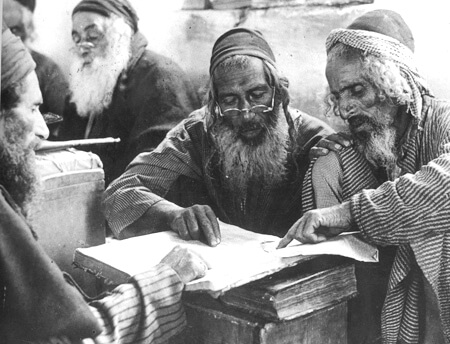
Moses commanded the people: "Pay attention (הַסְכֵּת) and listen!” (Deut. 27:9)
The word has-keit — “pay attention” — is unusual. The Talmud reads it homiletically:
Form groups (asu kittot) and study Torah; for Torah knowledge is only acquired through group study. (Berakhot 63b)
Intolerance, Ignorance, and Iniquity
Rabbi Yossi went further still. He warned that scholars who study in isolation are liable to acquire three destructive traits: intolerance, ignorance, and sin.
What is so terrible about studying by oneself?
The answer lies both in practical experience and in the very essence of Torah study.
On a practical level, there are three benefits when we study with others.
-
First, encountering opinions different from our own cultivates greater openness and tolerance. Those who study by themselves are not exposed to other perspectives and grow to be intolerant of dissent. This rigidity fuels disputes, hardens divisions, and breeds hostility.
-
Second, scholars who study alone or in small groups risk failing to properly understand matters of faith and fundamental Torah views. In these essential areas, they will remain ignorant and uninformed.
-
Third, solitary study can produce errors in Halachic judgment. Scholars who bear responsibility for others can cause harm when their legal decisions are misguided. Sometimes, their very isolation may lead them to needless stringency. These excessive burdens, like the case of the Nazarite, are counted as a form of sin.
Torah of Life
On a deeper level, isolation runs against the grain of Torah itself. The Torah is not a path of retreat from the world, but a Torat chaim, a Torah of life. It sanctifies the joys that enrich life and strengthen human connection. Its laws and mitzvot are designed for the home, the marketplace, and the community.
To withdraw into solitude, imagining that this leads to closeness with God, is foreign to the Torah’s vision. Such a path runs so contrary to Judaism, that even the pursuit of Torah wisdom is not meant to be a solitary quest, but a journey together with others.
(Adapted from Ein Eyah vol. II, pp. 389-390)