The Last Edge Harvested
One form of assistance that the Torah mandates for the needy is the mitzvah of pei'ah: the farmer must leave over a corner (pei'ah) of his field for the poor.
When you reap your land’s harvest, do not completely harvest the corners of your fields. ... Leave them for the poor and the stranger. (Lev. 19:9-10)
The Sages added a striking requirement: pei'ah must be the very last part of the field harvested. One may not designate it at the beginning or in the middle of the harvest. Why is this important?
By requiring pei'ah to be left to the end, the Torah effectively fixes a time when the poor may come and take their portion. The Talmud (Shabbat 23a) explains that this prevents four potential abuses:
-
Stealing from the poor. The landowner could set aside the pei'ah at some pre-arranged hour, ensuring that the produce goes to acquaintances rather than to those truly in need.
-
Wasted time. The poor will not need to hang around the field, waiting until the moment the owner arbitrarily decides to declare a section of his field as pei'ah.
-
Unwarranted suspicions. People might not know that the farmer set aside his pei'ah earlier, and suspect him of not fulfilling the mitzvah.
-
Swindlers. Dishonest farmers could falsely claim they had designated pei'ah earlier.
Rav Kook saw in these four concerns a broader vision of the Torah’s approach to charity.
Moral Duty
The very phrase “stealing from the poor” is revealing. Supporting the needy is not merely an act of generosity; it is a social and moral obligation. The Hebrew word for charity, tzedakah, derives from tzedek, meaning “justice.” Those who withhold aid are not simply ungenerous; they are, in effect, taking what rightfully belongs to others.
In general, the existence of poverty in the world should not be viewed as a purely negative phenomenon. There are many purposes to poverty, including its role in fostering moral and spiritual growth.
Empathy for the Poor
Yet if we focus only on obligation, we are seeing charity solely from the donor’s perspective. The Torah also insists on sensitivity to the recipient. The poor person’s time and dignity matter. He should not be made to linger in uncertainty, waiting for the landowner’s decision to set aside the corner harvest.
In short, the foundation of tzedakah is duty. But an attitude of empathy and understanding is necessary to truly fulfill the mitzvah of tzedakah.
Social Obligation
Social norms also play a role in supporting the weak and the destitute. Some give because they are embarrassed to be seen as stingy or indifferent; society honors generosity and censures neglect.
While the highest level of giving stems from inner conviction, not everyone reaches that level. For the good of society, the Torah affirms the importance of social pressure in encouraging support for the needy.
In the case of pei'ah, this is reflected in the concern for public perception. Even unfounded suspicion must be avoided, in order to uphold trust and accountability.
Stopping Swindlers
The final concern—preventing deception—addresses the lowest elements of society. Yet even this is sufficient to impose an obligation on all. Society functions as an organic whole: people influence one another, and no one is entirely immune to the moral decay that such a loophole can foster.
By closing the door to abuse, the Torah safeguards not only the poor, but the moral health of society.
(Sapphire from the Land of Israel. Adapted from Ein Eyah vol. III, pp.74-75)
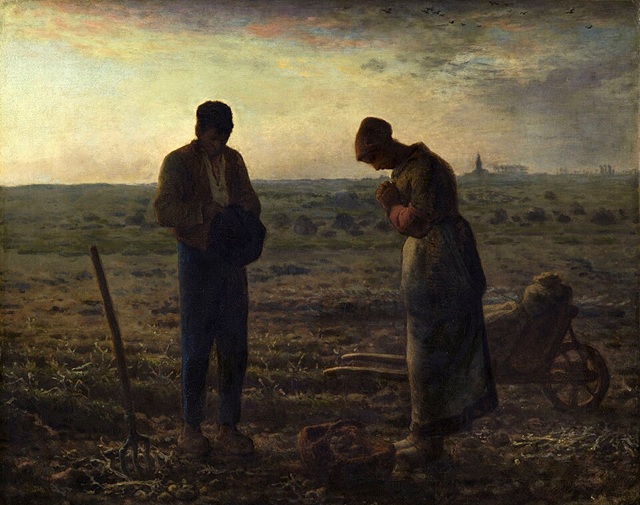
Image: "The Angelus" by Jean-François Millet (1857–1859)