A Warning from Eretz Yisrael
The sages in Eretz Yisrael were furious. True, Hananiah was a great scholar, among the greatest of his generation. But even after he left for Babylon, Hananiah continued to set the Jewish calendar, deciding whether to add a leap month and determining the first day of the month.
The sages dispatched two messengers to Hananiah with the following warning: “If you insist on setting the calendar outside of Israel, then go build your own altar and publicly declare that you and your community in Babylon have left the Jewish people and no longer belong to the God of Israel.” The Babylonian Jews were stunned to hear this message, wailing, “Heaven forbid! We are still part of the Jewish people!”
Why were the sages so disturbed by Hananiah’s setting the calendar in Babylon? The Talmud (Berakhot 63b) explains that their response was based on the verse, “For Torah will go forth out of Zion, and God’s word from Jerusalem” (Isaiah 2:3). The source of Torah — including determining the Jewish calendar — is Jerusalem and the land of Israel.
Why is it so important that Jerusalem be the center of Torah instruction?
Zion and Jerusalem
We must first understand this verse, “For Torah will go forth out of Zion, and God’s word from Jerusalem.” What is the difference between ‘Zion’ and ‘Jerusalem’?
While Zion and Jerusalem refer to the same locale, they indicate different aspects of the holy city. The word ‘Zion’ literally means ‘marked’ or ‘distinctive.’ It refers to those inner qualities that distinguish the Jewish people, “a nation who dwells alone” (Num. 23:9) with their own unique spiritual traits and aspirations. The name ‘Jerusalem,’ on the other hand, indicates the city’s function as a spiritual center for the entire world, influencing the nations of the world. ‘Jerusalem’ is the means by which Israel’s spirit of holiness penetrates and uplifts the inner life of distant peoples.
In short, ‘Zion’ looks inward, emphasizing the city’s internal significance for the Jewish people, while ‘Jerusalem’ looks outward, stressing the city’s universal role as a spiritual focal point for the world.
It is axiomatic that the spirit of Torah and its ideals can only flourish when the Jewish people observe the Torah’s mitzvot. For this reason, the verse first stipulates that “Torah will go forth out of Zion.” First the Jewish people must follow Torah and its mitzvot; only then can God’s word disseminate from Jerusalem to the rest of the world. The two parts of the verse thus correspond to the dual aspects of Zion-Jerusalem. First there must be Torah in Zion, focusing inward. Then “the word of God” — the universal prophetic message — can spread to the rest of the world, emanating from ‘Jerusalem,’ the international quality of the holy city.
The Sun and the Moon
What does all of this have to do with setting the calendar? There are two aspects to setting the Jewish calendar. The first is to determine the hour of the new moon, and the second is to calculate whether it is necessary to intercalate an extra month so that the lunar cycle will remain in sync with the solar year and the seasons.
In rabbinical literature, the sun is often a metaphor for the nations of the world, while the moon represents the Jewish people. Thus the two calculations of the calendar correspond to the two aspects of Zion-Jerusalem. We need to determine the time of the new moon in order to observe the special lunar calendar of Israel — this is the internal Torah of Zion. And we need to declare a leap year in order to maintain the proper balance between the lunar year of Israel and the solar year of the nations — this corresponds to the universal message emanating from Jerusalem.
The Torah of an Entire Nation
But why must the Jewish calendar be set in the land of Israel? The restriction on setting the calendar in Eretz Yisrael reflects a fundamental axiom of Torah. For the Torah to influence and enlighten the world, it must be established as a complete Torah, a Torah that governs all spheres of life. By setting the calendar outside of Israel, Hananiah disconnected the Torah from the myriad aspects of life as a nation living in its own land. He reduced the Torah to a personal religion that only relates to the ethical refinement of the individual and one’s private connection to God. Such an approach impoverishes the multifaceted richness of Torah. As the sages warned Hananiah, this was akin to setting up a private altar to serve God — an irreparable break from the true goal of Torah and the people of Israel.
To thwart such misguided views, the prophet declared, “For the sake of Zion I will not be silent” (Isaiah 62:1). First, Zion’s status as the center of Torah must be firmly established. Only then will the continuation of this prophecy be fulfilled: “Then the nations will see your righteousness, and all kingdoms your honor.”
(Silver from the Land of Israel. Adapted from Ein Eyah vol. II on Berakhot 63b (9:330).)
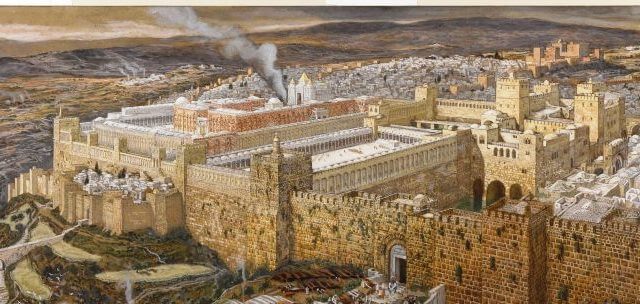
Illustration image: James Tissot, ‘Reconstruction of the Temple of Herod Southeast Corner’ (between 1886 and 1894)