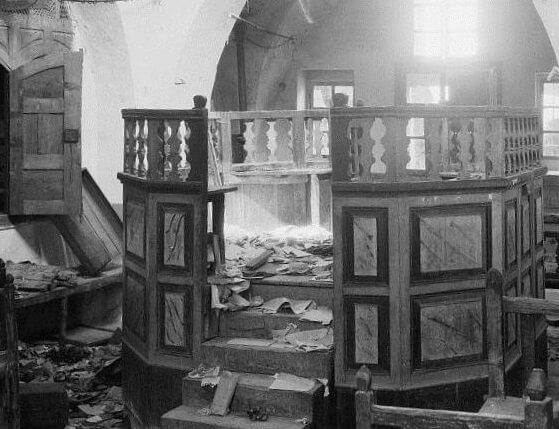
Sarah died in Kiryat Arba, also known as Hebron, in the land of Canaan. Abraham came to eulogize Sarah and to weep for her. (Gen. 23:2)
A somber gathering assembled in Jerusalem’s Yeshurun synagogue. The large synagogue and its plaza were packed as crowds attended a memorial service for the Jews of Hebron who had been killed in the Arab riots six months earlier, on August 24th, 1929.
On that tragic Sabbath day, news of deadly rioting in Hebron reached the Jewish leaders in Jerusalem. Yitzchak Ben-Zvi, then director of the National Committee, hurried to Rav Kook’s house. Together they hastened to meet with Harry Luke, the acting British High Commissioner, to urge him to take action and protect the Jews of Hebron.
The Chief Rabbi demanded that the British take swift and severe measures against the Arab rioters.
“What can be done?” Luke asked.
Rav Kook’s response was to the point. “Shoot the murderers!”
“But I have received no such orders.”
“Then I am commanding you!” Rav Kook roared. “In the name of humanity’s moral conscience, I demand this!”
Rav Kook held the acting commissioner responsible for British inaction during the subsequent massacre. Not long after this heated exchange, an official reception was held in Jerusalem, and Mr. Luke held out his hand to greet the Chief Rabbi. To the shock of many, Rav Kook refused to shake it.
With quiet fury, the rabbi explained, “I do not shake hands defiled with Jewish blood.”
The day after the rioting in Hebron, the full extent of the massacre was revealed. Arab mobs had slaughtered 67 Jews — yeshiva students, elderly rabbis, women, and children. The British police had done little to protect them. The Jewish community of Hebron was destroyed, their property looted and stolen. The British shipped the survivors off to Jerusalem.
The tzaddik Rabbi Arieh Levine accompanied Rav Kook that Sunday to Hadassah Hospital on HaNevi'im Street to hear news of the Hebron community by telephone. Rabbi Levine recalled the frightful memories that would be forever etched in his heart:
When [Rav Kook] heard about the murder of the holy martyrs, he fell backwards and fainted. After coming to, he wept bitterly and tore his clothes “over the house of Israel and God’s people who have fallen by the sword.” He sat in the dust and recited the blessing, Baruch Dayan Ha'Emet (“Blessed is the True Judge”).For some time after that, his bread was the bread of tears and he slept without a pillow. Old age suddenly befell him, and he began to suffer terrible pains. This tragedy brought about the illness from which the rabbi never recovered.
The Memorial Service
Six months after the massacre, grieving crowds filled the Yeshurun synagogue in Jerusalem. A mourning atmosphere, like that on the fast of Tisha B'Av, lingered in the air as they assembled in pained silence. Survivors of the massacre, who had witnessed the atrocities before their eyes, recited Kaddish for family members murdered in the rioting.
Rabbi Jacob Joseph Slonim, who had lost his son (a member of the Hebron municipal council) and grandchildren in the massacre, opened the assembly in the name of the remnant of the Hebron community.
“No healing has taken place during the past six months,” he reported. “The murder and the theft have not been rectified. The British government and the Jewish leadership have done nothing to correct the situation. They have not worked to reclaim Jewish property and resettle Hebron.”
Afterwards, the Chief Rabbi rose to speak:
The holy martyrs of Hebron do not need a memorial service. The Jewish people can never forget the holy and pure souls who were slaughtered by murderers and vile thugs.Rather, we must remember and remind the Jewish people not to forget the city of the Patriarchs. The people must know what Hebron means to us.
We have an ancient tradition: “The actions of the fathers are signposts for their descendants.” When the weak-hearted spies arrived at Hebron, they were frightened by the fierce nations inhabiting the land. But “Caleb quieted the people for Moses. He said, ‘We must go forth and conquer the land. We can do it!'” (Numbers 13:30)
Despite the terrible tragedy that took place in Hebron, we announce to the world, “Our strength is now like our strength was then.” We will not abandon our holy places and sacred aspirations. Hebron is the city of our fathers, the city of the Machpeilah cave where our Patriarchs are buried. It is the city of David, the cradle of our sovereign monarchy.
Those who discourage the efforts to restore the Jewish community in Hebron with arguments of political expediency; those who scorn and say, “What are those wretched Jews doing?”; those who refuse to help rebuild Hebron — they are attacking the very roots of our people. In the future, they will be held accountable for their actions. If ruffians and hooligans have repaid our kindness with malice, we have only one eternal response: Jewish Hebron will once again be built, in honor and glory!
The inner meaning of Hebron is to draw strength and galvanize ourselves with the power of Netzach Yisrael, Eternal Israel.
That proud Jew, Caleb, announced years later, “I am still strong... As my strength was then, so is my strength now” (Joshua 14:11). We, too, announce to the world: our strength now is as our strength was then. We shall reestablish Hebron in even greater glory, with peace and security for every Jew. With God’s help, we will merit to see Hebron completely rebuilt, speedily in our days.
Addendum
While some Jewish families did return to Hebron in 1931, they were evacuated by the British authorities at the outset of the Arab revolt in 1936. For 34 years, there was no Jewish community in Hebron — until 1970, when the State of Israel once again permitted Jewish settlement in Hebron. This return to Hebron after the Six-Day War was spearheaded by former students of the Mercaz HaRav yeshiva, disciples of Rav Kook’s son, Rabbi Zvi Yehuda Kook.
In 1992, Rav Kook’s grandson, Rabbi Shlomo Ra’anan, moved to Hebron. Six years later, an Arab terrorist stabbed the 63-year-old rabbi to death. But soon after, his daughter — Rav Kook’s great-granddaughter — along with her husband and children, moved to Hebron, thus continuing the special link between the Kook family and the city of the Patriarchs.
(Stories from the Land of Israel. Adapted from Malachim Kivnei Adam, pp. 155-157; 160; 164-165)