When to Bring the Omer?
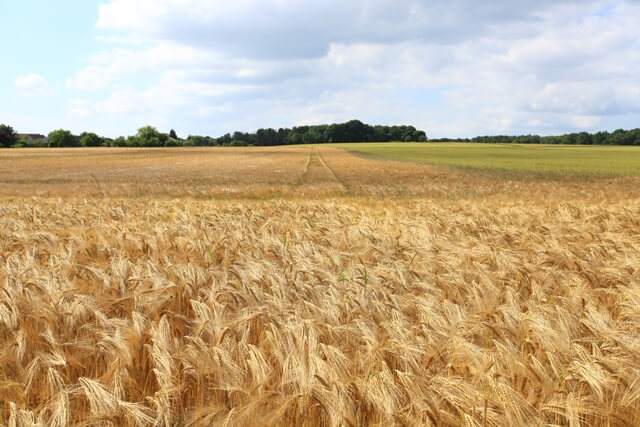
During the Second Temple Period, a fierce controversy raged concerning the date for bringing the springtime offering of barley, called the ‘Omer.’[1]
When you come to the land that I am giving you, and you reap its harvest, you must bring an omer of your first reaping... The kohen shall perform this wave-offering on the day after the Sabbath. (Lev. 23:10-11)
The verse says the Omer is to be offered “on the day after the Sabbath” — but which Sabbath? According to the Oral Tradition, this “Sabbath” is the first day of the Passover holiday.
But the Boethusians, a heretical Jewish sect during the Second Temple period, rejected this tradition. In general, the Boethusians did not accept the Oral Law, and favored a more literal understanding of the text. They argued that the Sabbath mentioned in the verse is the seventh day of the week; so the Omer must be offered on the day after the Sabbath, i.e., the first Sunday after Passover.
This dispute also determines the date for Shavuot, since the Shavuot holiday is celebrated seven weeks after the Omer offering.
The objection of the Boethusians cannot be ignored out of hand. Why indeed does the Torah speak of offering the Omer on the day “after the Sabbath”? If the verse had just used the word “Passover” or “festival,” the whole controversy could have been avoided!
The National Holiness of Israel
What is the source of the argument between the Boethusians and the Sages? The Talmud in Menachot 65a records that the Boethusians disagreed with another accepted Halachah. The Sages taught that the daily Temple offering (the Tamid) must be purchased with public funds. The Boethusians — many of whom were wealthy — argued that any individual could cover the cost for the daily offering. Why did they disagree with the Sages?
These three disagreements — acceptance of the Oral Law, recognizing Passover as the “Sabbath” mentioned in the verse, and requiring that the Tamid be purchased from public funds — are all connected to one fundamental question: what is the nature of the Jewish people? Is the nation merely the combined contribution of each individual Jew? Or are the Jewish people as a whole a national collective with its own special holiness?
The Boethusians did not recognize the concept of Knesset Yisrael, the collective soul of Israel, as an entity with its own intrinsic holiness. Rather, they viewed the Jewish people as any other people. For them, a nation is in essence a partnership, formed in order to benefit its members by way of social contract. The primary goal of this partnership is to help the individual — to provide the civil rights and benefits that each member gains from the overall partnership.
Jewish law in fact distinguishes between two concepts: tzibur (the collective) and shutafut (partnership). We find the Talmud in Temurah 13a rules that a korban tzibur, a public Temple offering, belongs to the entire Jewish people. Such an offering may not be substituted by an offering of partners, no matter how many people join in. Why not? Clearly, the collective of the Jewish people contains its own intrinsic quality of holiness, beyond the combined portions of all of its individual members. For this reason, the Sages insisted that public offerings be purchased through public funds, for only then will these offerings represent the entire nation.
The Boethusians rejected this idea of national sanctity. Thus they held that any individual may donate the daily Tamid offering, even though this is a korban tzibur of the entire people.
In general, the Boethusians did not accept the authority of the Oral Torah. This stance was similarly based on their view of the Jewish people. Unlike the Written Torah, which came directly from God, the Oral Torah is transmitted through the sages of Israel. The Oral Torah thus reflects the holiness of the Jewish people. As Rav Kook wrote in the opening paragraph of Orot HaTorah:
We sense that it is the nation’s spirit, with its distinctive character — bound to the light of the Torah of truth the way that a flame is tethered to a burning ember — that gave the Oral Torah the particular form in which it was forged.
But how does this relate to the disagreement over when to bring the Omer offering?
The relationship between the Sabbath and the holidays parallels the relationship between the Written and the Oral Torah. The Sabbath has a Divinely assigned, permanent holiness – keviya vekiyma — always set on the seventh day. The holidays, on the other hand, are bound to the holiness of the Jewish people. Their dates are established according to the Jewish court’s declaration of the start of each month, and its decision to add a leap month. For this reason, the holiday prayers conclude with the words, “Who sanctifies Israel and the holidays.” Why is Israel mentioned here? As the Talmud in Berakhot 49a explains: God sanctifies the Jewish people, who in turn sanctify the holidays.
Rooted in the Sabbath
In truth, the holiness of the nation is rooted in the holiness of the Torah. Similarly, the holiness of the holidays is rooted in the permanent holiness of the Sabbath. Thus the kiddush blessing refers to the Sabbath as “the first of the holy convocations.” The holiness of the holidays originates from the Sabbath, the first instance of holiness within the dimension of time, sanctified by God immediately following the Six Days of Creation.
Now we can understand why the verse refers to the Passover holiday as the “Sabbath” The first day of Passover is the very first holiday of the year, and the Torah wanted to teach us that the holiness of the holidays is based on the eternal holiness of Shabbat.
The Boethusians wanted to be like all other nations, with a national identity based on the rights of the individual and social contract. Therefore they could not accept the binding nature of the Oral Law, and they refused to acknowledge that the holidays are based on the intrinsic sanctity of the Sabbath. But with Divine assistance, the Sages were victorious. They succeeded in establishing for all times the Halachah regarding the public funding of the korban Tamid, as well as the date for offering the Omer and the holiday of Shavuot.
(Sapphire from the Land of Israel. Adapted from Mishpat Kohen, pp. 273-274)
An omer is a measure of volume, between 2 and 4 liters. This was the amount of barley flour baked and then brought in the Temple as a meal offering. ↩︎