The Blessings of Torah Scholars
The Talmud (Berakhot 50a) gives a litmus test to determine if an individual is truly a Torah scholar: listen to how he recites berachot (blessings). Clearly, when berachot are recited sincerely, they reflect a proper outlook on life and help instill important traits such as gratitude to God. What is less obvious is that even the detailed laws for blessings reflect fundamental concepts of the Torah. For this reason, Torah scholars are punctilious in their blessings.
Loving the Land of Israel
The following story gives one example of such an exacting approach to blessings. It also contains an important lesson about love for the Land of Israel.
Rabbi Hisda and Rabbi Hamenuna were seated at a meal, and were served dates and pomegranates. Rabbi Hamenuna made the blessing over the dates.
Rabbi Hisda asked him, ‘Do you not agree that those fruit mentioned earlier in the verse take precedence when reciting the blessing?’
Rabbi Hamenuna responded, ‘Dates are mentioned second after the word “land”, while pomegranates are only mentioned fifth.’
Rabbi Hisda exclaimed, ‘If only we had legs of iron to always follow you and learn from you!’ (Berakhot 41b)
The two scholars referred to the verse that praises the Land of Israel for seven grains and fruits:
It is a land of wheat, barley, grapes, figs and pomegranates; a land of oil-olives and honey-dates. (Deut. 8:8)
Rabbi Hisda felt that the blessing should reflect the order of the produce mentioned in the verse. Thus, pomegranates should come first.
Rabbi Hamenuna explained that while the order in the verse is indeed important, there is an even more important factor: how close is the fruit to the word “land” in the verse? Pomegranates are the fifth produce mentioned after the first time “land” appears in the verse; dates, however, are the second fruit mentioned after “land” appears a second time in the verse.
In other words, the position of dates in the verse indicates a greater closeness to the Land of Israel; therefore, this fruit deserves to come first.
The thought and care that Rabbi Hamenuna gave to his blessing demonstrates the importance he placed on loving Eretz Yisrael. This great love stems from recognizing the unique qualities of the Land — qualities that enable the Jewish people and all of humanity to attain spiritual goals. One who is closer to the Land of Israel, and demonstrates a greater connection to it, comes first for blessing. Such an individual is closer to the perfection that is attained through this special land.
Two Types of Love
Yet, we may ask: why is the word “land” mentioned twice in the verse? Why does the verse divide up the produce of Eretz Yisrael into two categories?
There are in fact two types of love for the Land of Israel. One’s appreciation for the Land is a function of his spiritual level and awareness. Some value Eretz Yisrael because of its unique spiritual qualities. They long “to take pleasure in her stones and love her dust” (Psalms 102:15) in order to fulfill the mitzvot that are connected to the Land. They recognize the blessings that Eretz Yisrael provides for the spiritual elevation of the Jewish people and the entire world.
Then there are those who appreciate the land for its material benefits. They recognize its value as a homeland for the Jewish people, and work towards settling and rebuilding the land. This form of devotion to the Land of Israel, even though it does not take into account its special spiritual qualities, is nonetheless a good and positive trait.
The verse mentions the word “land” twice, each time followed by a list of produce. This corresponds to the two forms of devotion to the Land of Israel. The first list of produce represents those who love the Land for its elevated, spiritual properties. This group consists of five fruits and grains, corresponding to the Five Books of Moses. This devotion to Eretz Yisrael is rooted in the world of Torah, from an awareness of the spiritual goals of the Jewish people and the entire world.
The second list contains oil-olive, symbolizing knowledge, and the honey-date, representing material contentment. These fruits represent those who appreciate the Land as a place where the Jewish people can be successful in the material spheres of life, whether academic, cultural, or economic.
Rabbi Hamenuna taught us an important lesson: how great is the love for the Land of Israel, even when this love is limited to its physical benefits. When they are connected to the community, all material matters become spiritual ones; the elevated goals will automatically be realized through the bonds of God’s people to His Land.
The Pomegranate and the Date
Why does the date take precedence over the pomegranate? Even though the pomegranate belongs to the first group, it is the last fruit in the list. The pomegranate represents those who are aware of the holy qualities of Eretz Yisrael, yet in practice remain distant from the Land. These individuals unfortunately take few practical measures to express their love for the Land.
The date, on the other hand, is near the top of the second group. It represents those who only recognize the material benefits of the Land of Israel. Through their efforts, however, they are much closer to the Land, taking practical steps in settling and rebuilding it.
Such a person, Rabbi Hamenuna taught, should be strengthened and given precedence for a blessing. Devotion to the Land, when promoted in practical, concrete efforts, is a wonderful thing. Thus we find the Talmud (Sanhedrin 102b) states that Omri merited to be king in reward for establishing a city in the Land of Israel, even though his intentions were certainly pragmatic.
Legs of Iron
Now we can understand Rabbi Hisda’s fervent response, “If only we had legs of iron to always follow you and learn from you!” Rav Hisda understood the inner message of Rabbi Hamenuna’s teaching. One needs "legs of iron” — courage and fortitude like iron — in order to be able to receive this remarkable message, and appreciate the importance of the material strength of Israel.
Similarly, on the national level, we need “legs of iron,” powerful means to build up the physical aspects of the nation. Then we will possess the spiritual strength to create a courageous national spirit. “And we will learn from you” — we will follow your path of Torah, and merit inheriting the Land through love and wholeness and inner strength.
(Gold from the Land of Israel, pp. 304-306. Adapted from Ein Eyah vol. II, pp. 186-187; Olat Re’iyah vol. I, pp. 374-377.)
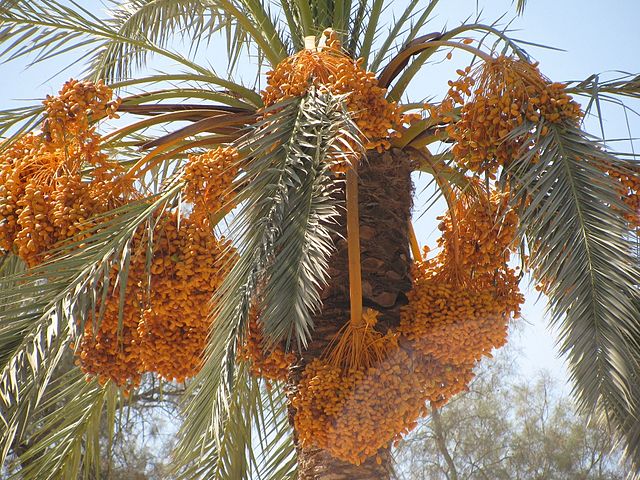
Illustration image: A palm tree full of date clusters in Eshkol Park in the Negev (PikiWiki)