The Merchant and the King
The Book of Deuteronomy is essentially a collection of Moses’ farewell speeches, delivered to the Jewish people as they prepared to enter the Land of Israel. The eloquence, passion, and cadence of Moses’ discourses are breathtaking. One can only wonder: is this the same man who claimed to be “heavy of mouth and heavy of tongue” (Ex. 4:10)?
The Sages were aware of this anomaly. The Midrash (Devarim Rabbah 1:7) offers the following parable to explain how eloquence is a relative matter:
This is like a man selling purple cloth, who announced, ‘Purple cloth for sale!’
Hearing his voice, the king peeked out and called the merchant over.
‘What are you selling?’ asked the king.
‘Nothing, Your Highness.'
‘But before I heard you call out, ‘Purple cloth for sale,’ and now you say, ‘Nothing.’ What changed?'
‘Oh no!’ exclaimed the merchant. ‘I am selling purple cloth. But by your standards, it is nothing.’
The same idea, the Midrash concludes, may be applied to Moses and his speaking abilities. When standing before God, Creator of the faculty of speech, Moses announced, “I am not a man of words” (Ex. 4:10). But when it came to speaking to the Jewish people, the Torah records: “These are the words that Moses spoke.”
Who May Be a Prophet?
In order to properly understand Moses’ claim that he possessed inferior oratory skills, we need to examine a basic question regarding the nature of prophets and prophecy.
In the Mishneh Torah, Maimonides describes the prerequisite character traits and intellectual qualifications to be a prophet. He then writes:
One who has perfected himself in all of these traits and is in perfect health when he enters the pardeis [i.e., when he studies esoteric wisdom] and is drawn to those lofty and abstract matters... immediately the prophetic spirit will come to him. (Yesodei HaTorah 7:2)
This description seems to indicate that prophecy is purely a function of one’s moral and spiritual preparation. Once one has attained the necessary spiritual level, he automatically merits prophecy.
However, Maimonides later writes that those who strive to attain prophecy are called “the sons of prophets” (see 2 Kings 2:15). Despite their intense efforts, they are still not full-fledged prophets. “Even though they direct their minds, it is possible that the Shechinah will inspire them, and it is possible that it will not” (ibid. 7:5). This statement indicates that attaining prophecy is not dependent only upon one’s initiative and efforts. Even those who have attained the appropriate spiritual level are not assured that they will receive prophecy.
How can we reconcile these two seemingly contradictory statements?
Natural or Supernatural?
Many aspects of the spiritual realm parallel the physical world. We find that the physical world is largely governed by set laws of nature and physics. Only on occasion does Divine providence intervene in the rule of nature. The same holds true for the hidden resources of the soul. There are set, general rules that govern their functions. But there are also situations that go beyond the natural faculties of the soul.
We may thus rephrase our question as follows: is prophecy a naturally occurring spiritual talent for those who prepare themselves appropriately? Or does it fall under the category of the supernatural, dependent upon God’s will at that time, when He chooses to perfect the world by way of prophetic message?
Ruach HaKodesh and Nevu'ah
To resolve this dilemma, we must distinguish between two types of prophecy. The first is an inner revelation in one’s thoughts, called ruach hakodesh. This is naturally attained Divine knowledge, a result of the soul’s nobility and its focus on lofty matters. This level of prophecy is a natural talent that God established within the soul.
There is, however, a second type of prophecy. This is nevu'ah, from the word niv, meaning ‘expression’ or ‘utterance.’ Nevu'ah is the consummation of the prophetic experience; prophecy goes beyond thought and is concretized in letters and words. This form of prophecy is not a natural faculty of the soul. It reflects a miraculous connection between the physical and spiritual realms, a supernatural phenomenon of Divine Will commanding the prophet to relay a specific message to the world.
We may now resolve the apparent contradiction in Maimonides’ writings. When he wrote that the prophet will automatically attain prophecy, Maimonides was referring to the prophetic insight of ruach hakodesh. From his description, it is clear that he is speaking about a prophecy experienced mentally:
His thoughts are constantly attuned to the holy. They are bound under God’s Throne, to grasp those holy and pure images, perceiving God’s wisdom [in all aspects of creation].
When, on the other hand, Maimonides spoke of nevu'ah, he wrote that even though the prophet directs his mind, he will not necessarily merit prophetic communion with God. This form of prophecy is dependent upon God’s Will, and not on the soul’s natural talents.
Moses’ Mistake
Now we can better understand Moses’ claim that he was not “a man of words.” Moses was certainly aware of his stature as a prophet. Maimonides teaches that a prophet “recognizes that he is no longer as he once was; but rather that he has been elevated above the level of other wise individuals.” Moses was aware of his spiritual level — but only as one worthy of ruach hakodesh, of a prophetic mental state. He assumed that the greater level of nevu'ah would be similarly recognizable by one who merited it. Since Moses did not sense this level of prophecy within himself, he declared that he was not a “man of words” — i.e., one meriting prophecy expressed in speech.
Moses’ reasoning, however, was flawed. The inner prophecy of thought is a natural talent of the soul and the result of the prophet’s spiritual efforts; thus the prophet is aware that he merits ruach hakodesh. The external prophecy of nevu'ah, on the other hand, depends on God’s Will, according to the dictates of Divine providence at that time. The first level is comparable to the laws of nature in the world, while the second is like supernatural miracles performed on special occasions. Thus nevu'ah does not reflect the inner qualities of the prophet’s soul.
God’s response to Moses is now clearer. “Who gave man a mouth? ... Who made him blind? Was it not I, the Lord?” (Ex. 4:11) The world has two sides, the natural and the supernatural. The mouth is part of the natural realm, whereas blindness is a special condition. Both, God told Moses, come from Me. Just as you attained the natural level of ruach hakodesh, so too, it is My will that you will be granted the supernatural level of nevu'ah.
The Prophetic Nature of Devarim
One final question: why is it that the Midrash only clarifies Moses’ oratorical skills in the book of Deuteronomy? The answer to this question is to be found in the difference between the prophetic nature of Deuteronomy as opposed to the other books of Moses.
Regular nevu'ah occurs in this fashion: the prophet would first hear God’s message, then the Divine Spirit would come over him, and he would relate what he had heard. The prophecy of Moses, however, was totally different. The Shechinah would “speak through his throat,” even as he spoke to the people. Moses was merely a mouthpiece for the Divine Presence.
As a result, the first four books of the Pentateuch do not demonstrate Moses’ oratory talents. The book of Deuteronomy, on the other hand, is a reflection of Moses’ talents in the same way that the prophetic books of other prophets reflect their individual style of speech.
Were it not for Deuteronomy, we could have taken Moses’ claim at face value and understood that he was literally “heavy of mouth and heavy of tongue.” But after reading the eloquent discourses of sefer Devarim, we realize that Moses was in fact referring to his prophetic abilities. Moses meant that he was unworthy of verbal nevu'ah. With regard to ordinary speech, however, Moses was only “heavy of mouth” in comparison to the King of the universe.
(Sapphire from the Land of Israel. Adapted from Otzarot HaRe’iyah vol. II, pp. 131-133 (originally published in Itur Sofrim))
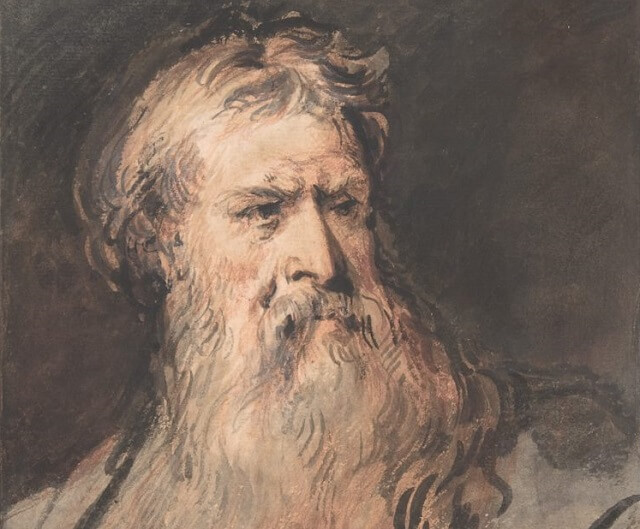
Illustration image: ‘Study for the figure of Moses’ (Jacob de Wit, 1730–37)