Rav Kook made the following comments when speaking at the inaugural ceremony for the Mizrachi Teachers Institute in Jerusalem during Chanukah, 1932:
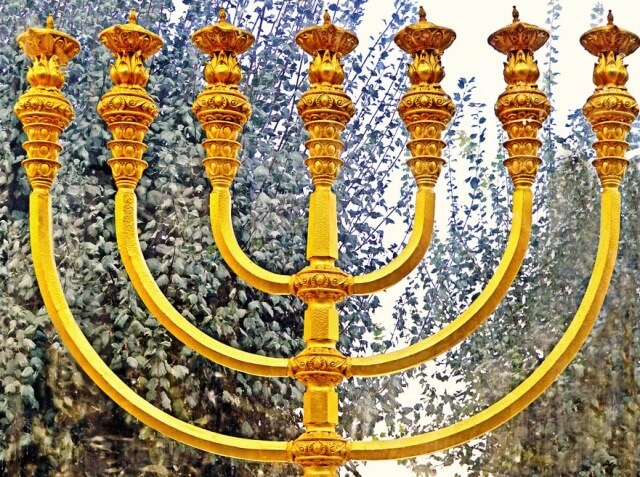
Why is it that the Menorah we use in our homes for Chanukah must be different than the Menorah in the Temple, bearing eight or nine branches instead of seven?
People think that kodesh and chol — the realms of sacred and secular — are adversaries battling one another. But in truth, there is no conflict between kodesh and chol. Our national life requires that both of these domains be fully developed and channeled toward building the nation. We should aspire to combine them and imbue the secular with holiness.
We strive for kiddush, to sanctify the mundane and extend the influence of kodesh on chol. But we also need havdalah to differentiate between the two realms. Havdalah is necessary to prevent the blurring of the boundaries between the sacred and the secular, to preclude the debasement of kodesh and its misuse for secular purposes.
There exists a perfect kodesh, lofty and sublime. We draw from its essence, from its content, from its living treasure. And we are commanded to protect it from any secular influences that could dullen the rich tapestry of the kodesh.
Thus, Jewish law forbids us to fashion a Menorah similar to the one used in the holy Temple. In this way, the kodesh defends itself from any flow of secular influences that may diminish its value. It is because of this self-protection that the kodesh is able to retain its power to strengthen and vitalize secular frameworks.
Greek thought asserted that there is no holiness in the practical world. The Greek mind could only see in the universe — from the lowest depths to the farthest stars — mundane forces. Knesset Yisrael, however, knows how to join heaven and earth. We know how to unite kodesh and chol, how to sanctify ourselves with that which is permissible, to eat a meal in holiness and purity.
We are able to attain this ideal unification because we maintain the necessary barriers, we know how to distinguish between the sacred and the secular. Eternal Israel is built on these complementary principles of chibur and havdalah, unification and distinction.
In an institution where both sacred subjects and secular disciplines are taught, we must not forget that our ancient battle against Greek culture is not over. If we are careless, the sacred will become profane.
We must remember that we are descendants of those heroes who sacrificed their lives to guard the holy. Like the Temple Menorah, Torah study is the highest level of kodesh. We must be careful that our study of Torah does not degenerate into a study of literature, not even a study of national literature or an ancient science. Torah is the word of the Living God. Our practical activities must be illuminated by the holy light of Torah and its mitzvot. As the psalmist said,
Your word is a lamp for my feet and a light for my path. (Psalms 119:5)
(Adapted from Mo'adei HaRe’iyah, pp. 181-182, and Celebration of the Soul by Rabbi Pesach Jaffe, pp. 99-100)