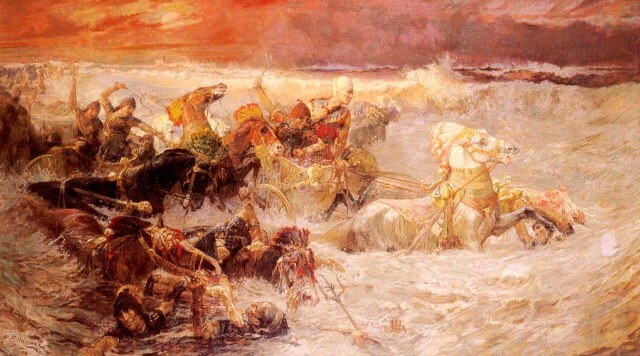
When the Israelites saw that they had been rescued from Pharaoh’s army at the sea, they sang out with gratitude:
זֶה אֵלִי וְאַנְוֵהוּ אֱלֹהֵי אָבִי וַאֲרֹמְמֶנְהוּ.
This is my God, and I will enshrine Him;
My father’s God, I will exalt Him. (Exodus 15:2)
Is the repetition in this line from Shirat Hayam — the “Song at the Sea” - merely poetic? Or is there a deeper significance to the two halves of the verse?
Although not apparent in translation, the verse uses two different names of God. The first half of the verse uses the name El, while the second half uses Elokim. What is the significance of each name? How do they specifically relate to the desire to “enshrine” and “exalt” God?
Natural and Contemplative Love
The song, Rav Kook explained, refers to two types of love for God. The first is a natural appreciation for God as our Creator and Provider. God, the Source of all life, sustains us every moment of our lives. All things are inherently drawn to their source, and this love for God comes naturally, like our innate feelings of love and respect for our parents.
This natural love of God corresponds to the Divine name El. The word El is in the singular, reflecting an appreciation for God as the only true power and the ultimate reality of the universe.
A second, higher form of love for God is acquired by reflecting on God’s rule of the universe. As we uncover God’s guiding hand in history, and we recognize the underlying Divine providence in the world, we experience a higher love of God. This love corresponds to the name Elokim — in the plural — referring to the myriad causes and forces that God utilizes to govern the universe.
Enshrine and Exalt
These two types of love differ in their constancy. Our natural love of God as our Creator should be constant and unwavering, like our love and respect for our parents. But the higher love, the product of contemplation and introspection, is nearly impossible to sustain continually due to life’s distractions.
Regarding the innate love of God, the verse speaks of “enshrining” God. With this natural emotion, we can create a permanent place — a shrine of reverence and love for God — in our hearts. “This is my God, and I will enshrine Him.”
The higher, contemplative love, on the other hand, does not benefit from this level of constancy. We should always strive for an ever-deeper appreciation and reverence for God. This is a spiritual goal, attained through our intellectual faculties. Regarding this aspect of love, it is appropriate to speak about “exalting” God. This indicates a love that is the product of concentrated effort. “My father’s God, I will exalt Him.”
(Adapted from Olat Re’iyah vol. I, p. 235)
Illustration image: ‘Pharaoh’s army engulfed by the Red Sea’ (Frederick Arthur Bridgman, 1900)