The Torah introduces the creation of the universe, not once, but twice. In the first chapter of Genesis, it says:
In the beginning, God (Elokim) created heaven and earth. (Gen. 1:1)
And in chapter two, it says:
These are the chronicles of heaven and earth when they were created; on the day that the Lord God (Hashem Elokim) made earth and heaven. (Gen. 2:4)
Two Accounts of Creation
When we examine these two verses, the most prominent difference between them is the name used for God. The first chapter uses the name Elokim — a name that corresponds to the Divine attribute of Justice (Midat Ha-Din). This aspect of creation is also called Gevurah (Strength), as the ability to meet the strict standards of unmitigated justice provides strength and legitimacy. If we can measure up to the attribute of Divine justice, we deserve to live.
The second chapter uses a combination of two names for the Creator: Hashem Elokim. The Torah precedes the name Elokim with the Tetragrammaton. This ineffable Divine name signifies the Divine trait of Mercy (Rachamim). It indicates that the world did not deserve to exist on the basis of its own merits. Creation of the universe required that the attribute of Justice be tempered with a measure of Mercy.
Combining Mercy and Justice
Why this change in God’s name? The Midrash explains that a fundamental shift took place during the process of creation:
Initially, God intended to create it with the attribute of Justice. But then He saw that the world cannot exist [with only Justice], so He gave priority to the attribute of Mercy, and joined it with the attribute of Justice. (Pesikta Rabbati 40)
The combination of two opposing traits, Mercy and Justice, is the foundation for the middle path that enables the universe to exist. The admixture of Mercy permitted free choice and the possibility that we may fall under the influence of evil. It created a reality where human frailties and foibles are tolerated.
When did this compromise become necessary? And why not create the world from the start with both attributes? Did God not know that the world cannot survive according to the judgement of unmitigated Justice?
The Inner Unity of the Garden of Eden
Corresponding to these two Divine traits, we may classify all mitzvot as either positive or negative commandments. At the heart of all positive commandments are the attributes of love for God (Ahavah) and Mercy. The negative commandments, on the other hand, are rooted in awe of God (Yirah) and Justice.
According to the Zohar, God instructed Adam regarding both categories of mitzvot in the Garden of Eden. Man was placed in the Garden “to work it and watch over it” (Gen. 2:15). “To work it” (le-ovdah) refers to fulfilling God’s positive commandments, while “to watch over it” (ul-shomrah) refers to observing the negative precepts.
In the Garden of Eden, however, there existed an underlying unity encompassing both of these Divine attributes. There is an inner connection between the qualities of Justice and Mercy. While all negative precepts are based on Yirah, the actual command to feel awe and reverence for God is itself a positive mitzvah (see Deut. 10:20). Deep within the attribute of Yirah lies hidden the attribute of Ahavah. Just as there is Love concealed within Awe, so, too, there is Mercy concealed within Justice. This form of Justice, containing a hidden measure of Mercy, was the original master-plan for creation.
Also the Tree of Knowledge combined two opposing qualities; it contained knowledge of good and evil. Adam could not grasp how one tree could encompass two contradictory traits. In truth, this combination is the very foundation of our world. The universe could not exist without combining Justice with Mercy. Adam’s sin was that he separated between the two, thus transforming the Garden of Eden into a broken, disjointed world.
Return to the Garden of Eden
What about the original plan for the world, to exist exclusively by Justice? This level of creation will be attained in the future, as the world is repaired. (Thus there is a tradition that in the future the Halachah will be decided according to the more stringent opinion of Beit Shammai.) Since the universe will return to the original design of Justice, the term “Gan Eden” refers both to the past and the future. The Garden of Eden was the pristine, integrated world that existed before Adam’s sin; and it is also the future place of reward.
In our divided reality, deed and reward are separated in time and place:
Today [this world] is for keeping the commandments; and tomorrow [the world to come] is for receiving their reward. (Eiruvin 22a)
In the Garden of Eden, on the other hand, there is no dichotomy between action and reward, no confusion between good and evil, and no divide between the traits of Justice and Mercy. In the future, the universe will return to the Divine attribute of Justice, with Mercy concealed within, thus uniting all apparent opposites.
(Adapted from Shemuot HaRe’iyah 8, Bereishit 5690 (1929))
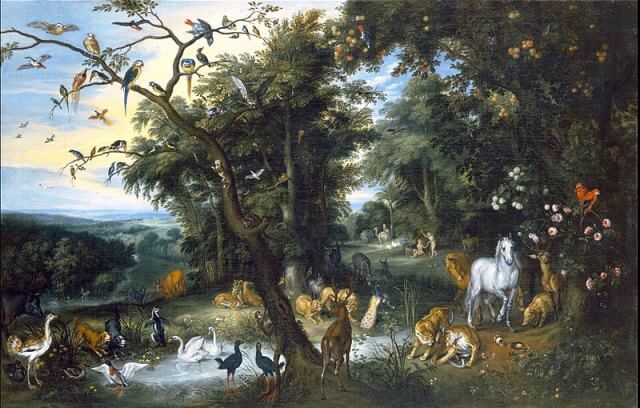
Illustration image: Izaak van Oosten, ‘The Garden of Eden’ (between 1655 and 1661)