Immediately before leaving Egypt, the Israelites were commanded to commemorate the final plague of makkat bechorot, the death of the firstborn, by consecrating their firstborn, saying:
When Pharaoh stubbornly refused to let us leave, God killed all the firstborns in Egypt, both man and beast. I therefore offer to God all male firstling animals, and redeem all the firstborns of my sons. (Exod. 13:15)
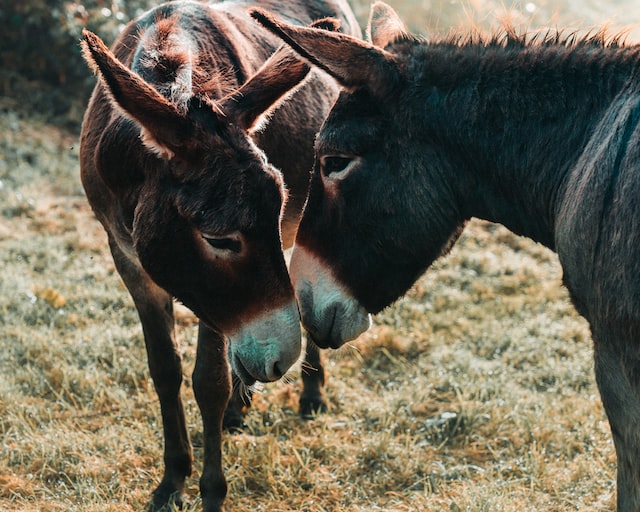
This mitzvah applies not only to firstborn babies, but also to kosher animals, and — surprisingly — to firstborn donkeys: “Every firstling donkey must be redeemed with a sheep” (Exod. 13:13).
Why are firstborn donkeys also included in this mitzvah?
This is even more surprising when we consider that some non-kosher animals, such as camels and pigs, have only one sign of impurity. Donkeys, however, exhibit both signs of impurity — they are not ruminants, nor do they have cloven hooves. The Zohar teaches that the donkey is avi avot ha-tumah, the ultimate source of impurity.
In addition, the Maharal of Prague noted that the Hebrew word for ‘donkey’ (chamor) shares the same root as the word for ‘material’ (chomer). The donkey, he explained, is a symbol of materialism and crassness.
So why did God bestow the special holiness of bechor on this ignoble creature?
Hidden Holiness
One explanation proposed by the Sages in Bechorot 5b is that donkeys helped facilitate the Exodus, as they hauled the treasures of Egyptian gold and silver for the Hebrew slaves. Yet the Israelites could have used some other pack animal. It would appear that there is something special about the donkey, that it symbolizes an inner truth about the redemption of the Jewish people, both in Egypt and in the future national rebirth of the Messianic Era.
The Israelites in Egypt had sunk to the lowest levels of idolatry and impurity. Outwardly, they were indistinguishable from their Egyptian neighbors. According to the Midrash, even the angels were unable to distinguish between the two nations. They questioned God’s decision to rescue the Israelites at the Red Sea, protesting, ‘Both the Egyptians and the Israelites worship idols!’
But as with the donkey, the impurity of the Jewish people was only on the surface, hiding a great inner holiness. It was a superficial defect, as it says, “Do not look upon me [disdainfully] because I am black; for [it is only] the sun that has darkened me” (Song of Songs 1:6).
The Messianic Donkey
We find a similar idea with regard to the future redemption. The Sages noted that the prophets used conflicting metaphors to describe the Messianic Era. In Daniel’s nighttime vision, the Messianic king arrives “on the clouds of the heaven” (7:13). The prophet Zechariah, on the hand, spoke of a righteous king who makes his appearance as “a pauper, riding on a donkey” (9:9). So how will the Messiah arrive — floating on clouds, or sitting on a donkey?
Rabbi Yehoshua ben Levi explained that the Messiah’s form of transportation depends on us:
If [the people of Israel] merit, he will come ‘on heavenly clouds.’ If they do not merit, then he will be ‘a pauper riding on a donkey.’ (Sanhedrin 98a)
In other words, if the Jewish people attain a spiritual level high enough, they will merit a supernatural redemption replete with wonders and miracles — the Messianic king on clouds. If, however, the redemption arrives because the final hour has come, but the Jewish people are not worthy — then the redemption will unfold through natural means (see Ohr HaChaim on Num. 24:17).
Thus, “a pauper riding on a donkey” is a metaphor for an undeserved redemption, a redemption that comes despite a poverty of merits. It is a redemption based on natural processes, as exemplified by the donkey, a symbol of the material world. Yet this donkey, while externally crass and impure, has a special holiness hidden within — the holiness of the firstborn.
According to Rav Kook, the image of the Messiah arriving on a donkey characterizes the period of Ikveta deMashicha, the generation when the ‘footsteps’ (ikvot) of redemption are first heard. The Talmud ( Sotah 49b) describes this era as a time of terrible spiritual decline, replete with brazenness, immorality, and corruption.
But the Zohar asserts that, despite its external faults, the generation will be “good on the inside.” This inner goodness is reflected in the unusual nature of the Jewish people in the pre-Messianic Era. Despite the darkness clouding their behavior and beliefs, they are characterized by an innate holiness, which finds expression in their great love for the Jewish people and the Land of Israel.
The Function of Chevlei Mashiach
The Sages indicated the deeply disturbing nature of Ikveta deMashicha with the term chevlei mashiach, the ‘birth pangs’ that precede the Messianic Era. In his seminal work, Orot, Rav Kook discussed various reasons for the intensified degree of materialism that characterizes the era of national revival. His central argument is that the Messianic ‘birth pangs’ come to correct an imbalance stemming from centuries of stateless dispersion.
Rav Kook explained the process using the following analogy. The dregs at the bottom of a wine bottle help preserve the wine. If a bottle lacks dregs, and we wish to correct the situation by adding dregs, the initial result will be to muddy the entire bottle, temporarily ruining it. But as the dregs settle at the bottom, the wine regains its clarity and benefits from the preservative nature of the dregs.
So too, involvement in material pursuits is necessary to ensure the flow of normal life. The exile, with its concentration on spiritual matters, enervated the life-force of the Jewish people to such an extent that their national survival was in danger. The Jewish people needed to return to their land in order to survive as a nation. The return to the land and to a more balanced national life meant greater involvement in life’s material aspects.
Thus the early pioneers were occupied primarily with the physical revival of the Jewish people in Eretz Yisrael — draining swamps, planting crops, building cities, establishing defense organizations, political institutions, and so on. Initially, the crassness and brazenness of the pre-Messianic Era are cause for great consternation. But as the negative forces are subdued, like the settling of the wine dregs to the bottom of the bottle, their detrimental aspects dissipate.
Transforming Darkness to Light
The period of Ikveta deMashicha is a difficult time, and not all the Sages were eager to experience it. Rav Yosef, however, demonstrated great spiritual courage, saying, “Let the Messiah come; and may I merit to sit in the shadow of his donkey’s dung” (Sanhedrin 98b). Once again, we find the metaphor of the donkey used in connection with the Messianic Era.
Rav Yosef was accustomed to looking at the inner essence of things. He recognized the tremendous inner holiness hidden in this problematic generation, as symbolized by the Messiah’s donkey. Rav Yosef understood that the Messianic light will demonstrate how to utilize all forces, even the most coarse — “the donkey’s dung” — for the sake of good. He knew that the darkness of national rebirth will lead to an even higher light of Torah and knowledge of God.
(Sapphire from the Land of Israel. Adapted from Iggerot HaRe’iyah vol. II, p. 188, letter 555 (1913) (Igeret Takanah); Orot p. 85 (Orot HaTechiyah, sec. 45))
Illustration image: Photo by Ansgar Scheffold on Unsplash