The Israelites did as Moses had said. They requested silver and gold articles and clothing from the Egyptians. God made the Egyptians respect the people, and they granted their request. The Israelites thus drained Egypt of its wealth. (Exodus 12:35-36)
God’s command that the Hebrew slaves request gold and silver from the Egyptians is commonly explained as reparations for hundreds of years of slave labor. But why was it necessary to completely drain Egypt of its wealth?
The Talmud (Berakhot 9b) describes this ‘draining’ of Egypt with two different metaphors:
Rav Ami said: they made Egypt like a trap without bait.
Resh Lakish said: they made Egypt like a net without fish.
What do these metaphors mean? What is the difference between a “trap without bait” and a “net without fish”?
Trap without Bait
We find that the Torah prohibits returning to Egypt in order to prevent the Jews from falling once again under the spell of the idolatrous Egyptian culture. The Canaanites also worshipped idols, yet Egypt posed a bigger threat to the spiritual purity of the nation. Having lived there for centuries, the Jewish people were comfortable with all aspects of Egyptian life, including their idolatrous practices.
In order to neutralize the attraction of Egypt, it was necessary to impoverish the country. One of the principal reasons for migrating to another land is the possibility of increasing personal wealth. But without its gold and silver, the Egyptian economy was in shambles. It was like a “trap without bait” — the country held no real incentive to lure back Jews seeking to do business there.
Net without Fish
There could be, however, a second factor in the decision of certain individuals to return to Egypt. The local culture and arts, the Egyptian lifestyle, so familiar to the newly freed slaves, could also serve as a lure to draw back nostalgic former residents.
Resh Lakish therefore compared Egypt to a “net without fish.” Fish swim together, and are more likely to be drawn to a net that has already caught other fish. By draining Egypt of its wealth, not only was the country devastated economically, but it also suffered from a dramatically lower standard of living and poverty of culture. The final memories of the departing Israelites would be of an impoverished land whose remaining inhabitants struggled to eke out a living. It would be a “net without fish,” holding little enticement for them to return.
(Gold from the Land of Israel. Adapted from Ein Eyah vol. I, p. 45)
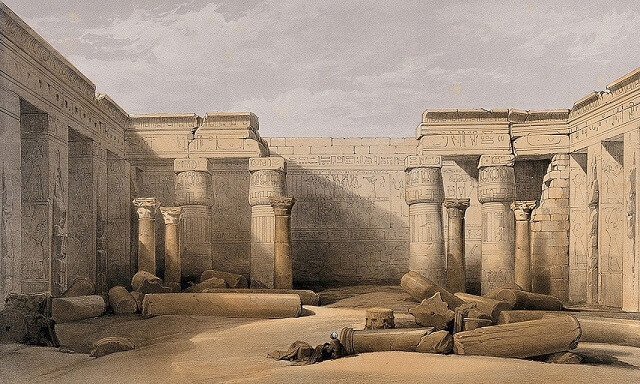
Illustration image: Ruins at Medinet Abou, Thebes, Egypt (David Roberts; Louis Haghe, 1847)