Transient Holiness
Our sense of holiness and closeness to God is not constant; there are times when we experience a heightened spiritual awareness. These moments reflect a transient holiness — kedushat sha’ah.
Also in the life of the nation, there are special times of kedushat sha’ah. This is the central theme of Sefer Bamidbar (the Book of Numbers), which recounts Israel’s unique experiences during their forty-year sojourn in the Sinai desert — a time when bread fell from the heavens and water spouted from rocks, a time of Divine protection and unparalleled prophetic revelation.
The book of Bamidbar opens with the words:
God spoke to Moses in the Sinai Desert in the Communion Tent. (Num. 1:1)
The terms ‘Sinai Desert’ and ‘Ohel Mo'ed’ (Communion Tent) are motifs repeated throughout Sefer Bamidbar. They call our attention to the special kedushat sha’ah of that generation.
Unlike Jerusalem’s permanent holiness, the holiness of Mount Sinai was temporary, lasting only for the duration of Matan Torah, the Revelation of the Torah at Sinai. Unlike the permanence of the Temple — a durable structure — the Tabernacle was provisional — a portable tent. And unlike the 613 mitzvot that apply in all ages, the special mitzvot that God commanded the Israelites in the desert — how to encamp, the signal blasts, the order of transporting the Tabernacle — only obligated that generation.
One should not think that kedushat sha’ah is on a lower level than permanent holiness. On the contrary, it is precisely because of its loftiness that this holiness cannot last forever. The deficiency is not in it, but in we who experience it. We are unable to maintain this level of holiness on a continual basis.
One example of the temporary holiness of Sefer Bamidbar was the Israelites’ use of special banners for each tribe in the encampment. The Midrash explains that these flags were given to Israel due to their desire to emulate the angels. Angels appeared at Matan Torah in chariots bedecked with flags, and the Israelites wanted to have similar flags. These flags correspond to the temporary holiness of Mount Sinai and Matan Torah. They reflect the special holiness of angels, a holiness beyond the reach of the human soul.
Moses and Aaron
The dichotomy between temporary and permanent holiness also existed in that generation’s leaders: Moses and Aaron. Moses served as the kohen during the Tabernacle’s dedication — a priesthood of kedushat sha’ah lasting only one week. Aaron, on the other hand, commenced a lineage of kohanim for all generations. Even today, kohanim emphasize their connection to Aaron’s permanent holiness in the blessing they recite, “Who sanctified us with the sanctity of Aaron.”
The founding of the Jewish people required both types of holiness. They needed both Moses and Aaron, both kedushat sha’ah and kedushah la-dorot. The events recorded in Sefer Bamidbar took place during an era of miracles and unique Divine providence, the historic revelation at Sinai, and Moses’ unparalleled prophetic vision in the provisional Ohel Mo'ed. But it was also the time to establish the foundations for Israel’s permanent holiness, to set down the Torah and mitzvot that would guide all future generations.
(Sapphire from the Land of Israel. Adapted from Shemuot HaRe’iyah 5689 (1929).)
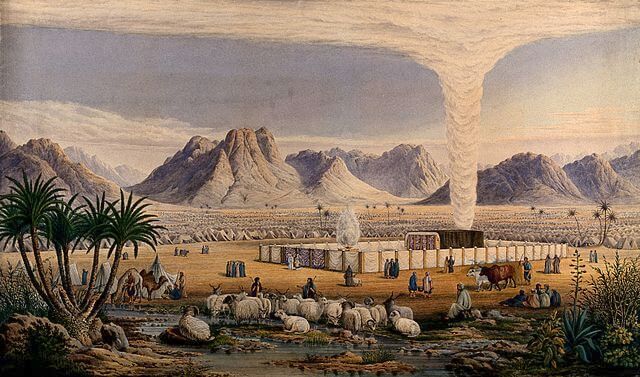
Illustration image: The Israelites’ encampment in the wilderness (J.J. Derghi, 1866)