Unlike Jewish servants who are automatically freed after six years, non-Jews who sell themselves into slavery are never released from servitude, as it says, לְעֹלָם בָּהֶם תַּעֲבֹדוּ — “You shall have them serve you forever” (Lev. 25:46). Unless the slave has been mistreated, he should not be set free.
Communal Mitzvah
There is, however, an exception that allows the owner to release his slave. This intriguing case sheds light on the overall function of slavery and its place in history.
The Talmud relates that Rabbi Eliezer once entered a synagogue, only to discover that there were not enough Jews to comprise a minyan (prayer quorum). Rabbi Eliezer immediately freed his gentile servant — when freed, a slave becomes Jewish — so that the congregation could pray.
The Sages explained that, even though it is ordinarily forbidden to free slaves, one may do so for a “mitzvah of the community” — mitzvah de-rabim.
Why does the Torah forbid owners from freeing non-Jewish slaves? And why is it permitted for a communal mitzvah?
The Function of Slavery
For the past few hundred years, slavery has been universally recognized as a corrupt and immoral institution. This is certainly the case when slave-owners are cruel and unconcerned about the welfare of their slaves. The Torah’s concept of slavery, however, relates to owners who are moral and upright people. As long as there are people who, due to moral weakness, are base and unscrupulous, it makes sense to entrust their welfare and moral instruction to the guidance of noble and exemplary individuals.
Yet, even this enlightened version of slavery was not intended for all times. Slavery will be annulled when “the world will be filled with knowledge of God” (Isaiah 11:9). When all the nations will “call out in the name of God” in a pure language, the institution of slavery will no longer be needed.
Until that future era, it is forbidden to free a gentile slave. Such an act would imply that the Torah does not provide superior ethical guidance to those who keep its mitzvot, and the slave gains no moral benefit when mentored by such a master.
Readiness to Join Society
For a communal mitzvah, however, it is permitted to free a slave. This type of mitzvah is not just a mitzvah performed by many individuals. Ordinarily, a mitzvah helps advance the perfection of an individual. A mitzvah de-rabim, however, relates to the perfection of all creation. A communal mitzvah alludes to the future era, a time when there will no longer be wicked people who need the framework of slavery to guard over them and guide them.
When all of humanity will strive to serve God and know His ways, slavery in its current form will no longer exist. Yet, just as we are happy to be of service to saintly individuals, in the future there will also exist a form of voluntary servitude, when:
Ten men of all the languages of the nations shall take hold of the hem of a Jewish man, saying, ‘Let us go with you, for we have heard that God is with you.'(Zechariah 8:23)
At that time, a person will grow spiritually by assisting the rest of creation. There will be many forms of mitzvah de-rabim, communal mitzvot that justify the release of slaves.
Even nowadays, we can explain that slavery is for selfish people who look out for their own needs and wants, even at the expense of others. When a slave is able to recognize that his own true success is dependent upon the success and prosperity of the community, he no longer requires this framework. Ordinarily, releasing a slave carries potential pitfalls, either for the slave himself or for his descendants. But a slave who yearns to assist the community is certainly ready to be freed. His engagement in a mitzvah de-rabim demonstrates his readiness to become a full member of society.
(Adapted from Ein Eyah vol. II, pp. 214-215)
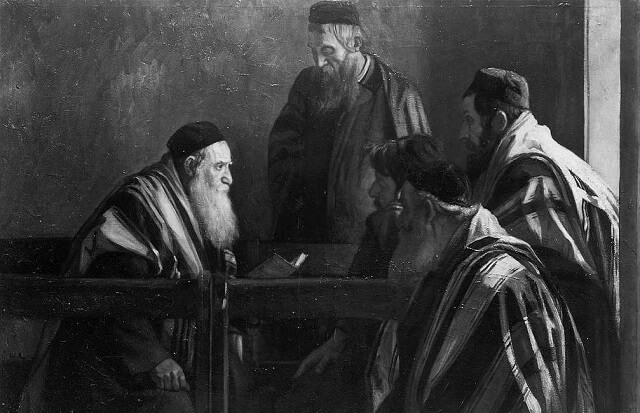
Illustration image: ‘Exposition of the Talmud’ (Sir William Rothenstein, 1872–1945)