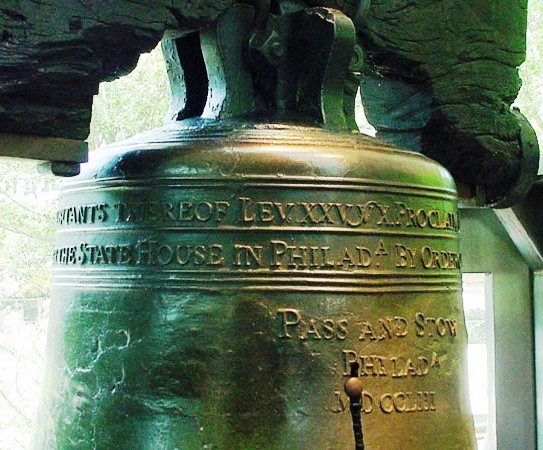
In 1751, the Pennsylvania Assembly ordered a special bell be cast, commemorating the 50th anniversary of William Penn’s “Charter of Privileges.” The Speaker of the Assembly was entrusted with finding an appropriate inscription for what later became famous as the Liberty Bell. The best expression of freedom and equality that the speaker could find was the Biblical verse describing the Jubilee year:
You will blow the shofar on the tenth day of the seventh month; on Yom Kippur you will blow the shofar in all your land. You shall sanctify the fiftieth year, proclaiming freedom to all its inhabitants. (Lev. 25:9–10)
The triumphant announcement of the Jubilee year, with blasts of the shofar, takes place on the tenth of Tishrei. This date is Yom Kippur, the Day of Atonement.
Yet, this is a curious date to announce the new year. The Jubilee year, like any other year, begins on the first of Tishrei, on Rosh Hashanah. Why was the formal proclamation of the Jubilee year postponed until Yom Kippur, ten days later?
National Sabbath Rest
The Jubilee year is a super-Sabbatical year. Like the seventh year, agricultural labor is prohibited, and landowners forego all claims on produce grown during that year. The Jubilee also contains two additional aspects of social justice: the emancipation of slaves and the restoration of land to its original owner.
Just as the Sabbath day allows the individual to rest, so too the Sabbatical and Jubilee years provide rest for the nation. The entire nation is able to take a break from competition and economic struggle. The Sages noted that the phrase “Sabbath to God” appears both in the context of the weekly Sabbath and the Sabbatical year. Both are designed to direct us towards spiritual growth: the Sabbath on the individual level, and the Sabbatical year on the national level.
Healing Rifts in Society
The Talmud in Rosh Hashanah 8b relates that during the first ten days of the Jubilee year, the slaves were not sent home. Nor did they work. They would feast and drink, celebrating their freedom “with crowns upon their heads.” Only after the court blew the shofar on Yom Kippur would the newly freed slaves return home.
The freeing of slaves in the Jubilee year serves as an important safeguard for social order. Societies that rely on slave labor usually suffer from slave revolts and violent acts of vengeance by the underclass.[1]
Instead of attaining social justice through bloody revolt and violent upheaval, the Jubilee emancipation allows for peaceful and harmonious social change. The restoration of rights for the poor and disadvantaged becomes an inherent part of the societal and economic order.
Most significantly, during their final days of servitude, the freed slaves celebrate together with their former masters. The Torah also obligates the master to send off his servants with generous presents.[2] These conciliatory acts help heal the social and psychological wounds caused by socio-economic divisions and class estrangement. The national reconciliation reaches its peak on Yom Kippur, when the shofar exuberantly proclaimed freedom and equality.
Atonement for the Nation
Thus, the formal announcement of the Jubilee year is integrally connected to Yom Kippur. On that year, the Day of Atonement becomes a time of forgiveness and absolution, not only for the sins of the individual, but also for the sins of society.
(Gold from the Land of Israel, pp. 213-215. Adapted from the Forward to Shabbat HaAretz, p. 9.)
Slave revolts were recurring feature of ancient Rome. In the United States, the abolition of slavery was only achieved after a horrific civil war. ↩︎
When an indentured Jewish servant completes his term, the Torah requires that he be sent off with a parting gift (ha’anakah) in recognition of his service (Deut. 15:13–14). Interestingly, Sefer HaChinuch and Maharam of Rothenburg derived from this obligation a broader principle of providing severance gifts to workers. Israel’s 1963 Severance Compensation Law explicitly invokes this mitzvah as an ethical foundation. ↩︎