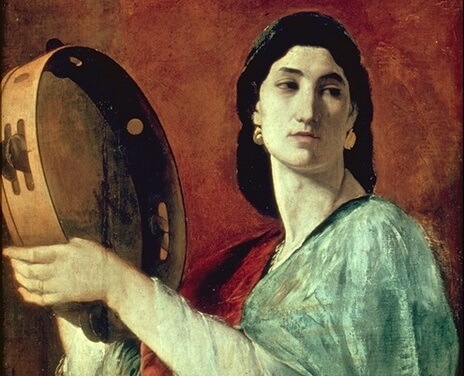
A Short Prayer for Miriam
When Miriam was stricken with leprosy, Moses beseeched God to heal his sister, saying a remarkably brief prayer: "Please God, please heal her” (Num. 12:13). The Talmud (Berakhot 34a) took note of the unusual brevity of this prayer in the following story:
Once, a student led the prayers in Rabbi Eliezer’s house of study, and his prayers were unusually lengthy. The other students complained, “Master, how slow this fellow is!”
Rabbi Eliezer responded to them, “He is no slower than Moses, who pleaded on behalf of the Jewish people [after the sin of the golden calf] for forty days and forty nights.”
On another occasion, a different student led the prayers. This student recited the prayers quickly. The other students complained, “How hasty this fellow is!”
This time Rabbi Eliezer replied, “He is no hastier than Moses, who pleaded for his sister’s recovery with a few short words.”
What determined the length of Moses’ prayers? Why did his own sister merit only a brief, one-line prayer?
Two Types of Prayer
Prayer serves two functions. The first function is to refine character traits and deepen awareness — either for the person praying, or for the one being prayed for. This type of prayer requires tenacity and perseverance, since correction of flawed traits requires extended effort, and usually occurs gradually over time.
For this reason, Moses needed to pray extensively when he prayed for the Jewish people after the calamitous sin of the golden calf. Why forty days? This period is the time it takes for an embryo to develop limbs and become recognizable as a human fetus. The forty days of Moses’ prayer indicated a rebirth of the Jewish people, with a new heart and spirit.
There is, however, a second function of prayer. Sometimes the inner emotions and character traits have already been refined and purified. Prayer only comes to put in words that which already exists in the inner soul. In such cases, an extended prayer is unnecessary; even a brief prayer may express many holy feelings. In the case of Miriam, she had already conceded her mistake. Her healing, both physical and spiritual, required only a short, simple prayer.
(Gold from the Land of Israel. Adapted from Ein Eyah vol. I, p. 163.)
Illustration image: Miriam by German painter Anselm Feuerbach, 1862.