Moses’ prayer when the Israelites traveled — a request that the Ark of Testimony would protect them from enemies — is very familiar to us, due to its central place in the synagogue ritual of opening the Torah ark:
וַיְהִי בִּנְסֹעַ הָאָרֹן, וַיֹּאמֶר מֹשֶׁה: קוּמָה ה’ וְיָפֻצוּ אֹיְבֶיךָ, וְיָנֻסוּ מְשַׂנְאֶיךָ מִפָּנֶיךָ.
“When the Ark traveled, Moses said, ‘Arise, O God, and scatter your enemies! Let your foes flee before You!'” (Num. 10:35)
Why the repetition in the verse? Is there a difference between enemies and foes? And how would the Ark scatter these adversaries?
Rav Kook explained that we are besieged by two kinds of opponents. Some are overt enemies, like Amalek. Others are hidden foes, dangers that we may not even be aware of. The Talmud tells the story of the second type of foe: enemy soldiers who attempted to attack Israel in stealth.
The Miracle at the Arnon Pass
As the Jewish people prepared to enter the Land of Israel, the Emorites (one of the Canaanite nations) laid a trap for them. They chipped away hiding places along a narrow pass in the Arnon canyon, across the Jordan River. Emorite soldiers hid in these crevices, waiting for the Israelites to pass through, when they could attack them with great advantage.
What the Emorites didn’t know was that the Ark would smooth the way for the Israelites in their travels through the wilderness. When the Ark arrived at the Arnon Pass, the mountains on each side crushed together, killing the concealed enemy soldiers.
The Jewish people traveled through the pass, blissfully unaware of their deliverance.
At the end of the Jewish camp, there were two lepers, named Et and Vahav. The last to cross through, they noticed that the riverbed washed red with blood from the sides of the canyon. The lepers realized that a great miracle had occurred, and they told the people. The entire nation, grateful for their deliverance, sang Shirat HaBe'er, the song of thanks recorded in Num. 21:17-18.
The Battles of Et and Vahav
The Talmud clearly relates to this story as a historical event, even prescribing a blessing to be recited when seeing the Arnon Pass. Rav Kook, however, offered an allegorical interpretation of the story.
Sometimes it is precisely those who are on the fringes who are most aware of the ideological battles that the Torah wages. The two lepers at the end of the camp of Israel represent two types of conflict that the Torah must confront. The Ark, containing the stone tablets from Sinai and Moses’ original sefer Torah, symbolizes the Torah itself.
The names of the two lepers are quite unusual — Et and Vahav. What do these peculiar names mean?
The word Et (את) in Hebrew is an auxiliary word, with no meaning of its own. However, it contains the first and last letters of the word emet (אמת) — truth. Thus Et is a symbol for the conflicts that originate from new ideas in science and knowledge. It is subordinate and related to absolute truth, but it lacks the middle letter, which is the substance of truth.
The word Vahav (והב) comes from ahava (אהבה), meaning love. (The two words share the same numerical value.) The mixing up of the letters indicates that this is an uncontrolled form of love. Vahav represents the struggle between free, unbridled living and the Torah’s principles; the contest between instant gratification and eternal values.
When these two adversaries — new scientific perceptions (Et) and the culture of living for immediate pleasures (Vahav) — join together, we find ourselves ensnared with no escape, like the Israelites who were trapped in the Arnon Pass. Only the light of the Torah - as represented by the Ark — can illuminate the way, crushing the mountains and defeating hidden foes. These enemies may be unnoticed by those immersed in the inner sanctum of Torah. But those at the edge, whose connection to Torah is tenuous, are acutely aware of these struggles and more likely to witness the victory of the Torah.
The Ark’s defeat of hidden adversaries, as the Jewish people began their conquest of the Land of Israel, is a sign for the Torah’s future triumph over its ideological adversaries in the current era of our return to the Land.
(Adapted from Ein Eyah vol. II, p. 246 on Berachot 44)
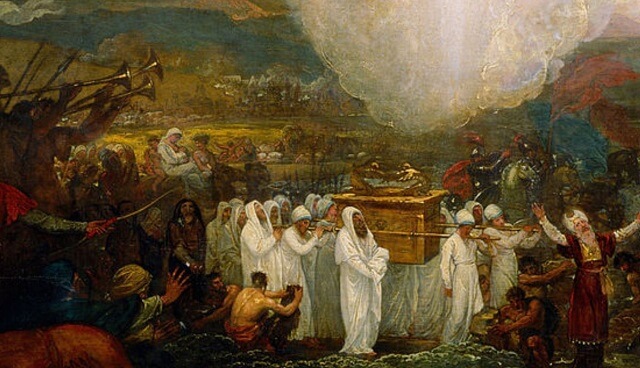
Illustration image: ‘Joshua passing the River Jordan with the Ark of the Covenant’ (Benjamin West, 1800)