The “Double Letters”
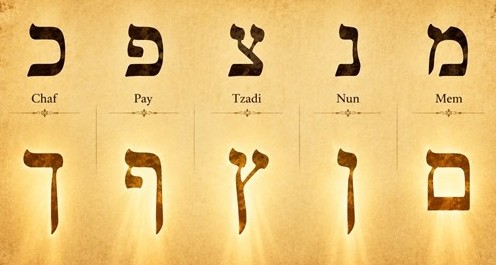
Of the twenty-two letters in the Hebrew alphabet, five are known as “double letters,” since they take on a different form when they appear at the end of a word.
The five letters are: Mem, Nun, Tzadi, Pay, and Chaf. When placed together as one word, they spell M-N-Tz-P-Ch.
According to Talmudic tradition (Shabbat 104a), the dual forms of these letters goes back to the prophets. The abbreviation M-N-Tz-P-Ch can be read as Min Tzophim, “from the prophets.”
From the Prophets
This claim — that the special forms of these letters originated with the prophets — requires clarification. The Torah of Moses is complete and whole in itself. Even a prophet may not add to it or invent a new mitzvah. The Torah explicitly declares,
These are the decrees, laws and codes that God set between Himself and Israel at Mount Sinai, through the hand of Moses (Lev. 26:46).
The phrase “These are the decrees” indicates that only the decrees that Moses set down in the Torah are in fact between God and Israel. How could the prophets alter the Torah by introducing new shapes of letters?
The Talmud explains that the prophets did not actually introduce anything new. There always existed two ways to write these five letters. Over time, however, it was forgotten which shape belongs at the end of the word, and which belongs at the beginning and middle. The prophets did not devise the two forms; they merely recovered the lost knowledge of which letterform belongs at the end of the word.
Why Two Forms?
Still, we need to understand: why do these letters have dual forms? What is the significance of their relative position in a word? And why was it the prophets, not the sages or the grammarians, who restored this knowledge?
Letters are more than just elements of speech. They are the building blocks of creation. The Sages taught, “The universe was created with ten utterances” (Avot 5:1). Each letter in the alphabet represents a fundamental force in the world.
Rav Kook explained that the final forms — the shapes that these letters assume at the end of words — are the holiest. The final forms most accurately portray the inner essence of each letter, fully expressing its ultimate purpose. To better understand this statement, we must examine the morphological differences between the two forms of these letters.
In four of the letters — נ צ פ כ (Nun, Tzadi, Pay, Chaf) — the regular form is smaller and more cramped. The “leg” of the letter is constrained and bent upwards. The form appearing at the end of the word (ן ץ ף ך), on the other hand, allows the “leg” to stretch and extend itself fully. It is the final form that truly expresses the full content and power of these letters.
Mem follows a different pattern. The regular Mem (מ) has a small opening at the bottom. It is known as the Mem Petuchah, the open Mem, exposed and accessible. It is open and revealed to all.
The final Mem (ם) is closed off on all sides. This is the Mem Setumah, the Sealed Mem. Or perhaps — the Esoteric Mem. This form of Mem is more sublime than the regular Open Mem. Thus, the holiest written object, the stone tablets engraved with the Ten Commandments, contained only Sealed Mems, with the center part of the Mem held in place miraculously. The final Mem is closed off and concealed. It guards its inner secret, which due to its profound holiness may not be revealed to all.
Why does the more elevated form appear at the end of the word? A hidden light appears at the ultimate vision of every noble matter. The hidden light of the M-N-Tz-P-Ch letters belongs to the end. The beginning and middle appearances of these letters are open and revealed. Their light steadily increases, until it brings us to the final, sublime conclusion.
The prophets are called tzofim, visionaries, as they were blessed with prophetic vision. Their greatness was that they could perceive the final outcome while still living in a flawed present. Understandably, it was these tzofim who recognized that the more elevated letterforms belong at the end.
(Gold from the Land of Israel, pp. 221-223. Adapted from Rosh Millin, pp. 35-36; Ein Eyah vol. IV, pp. 247-249.)