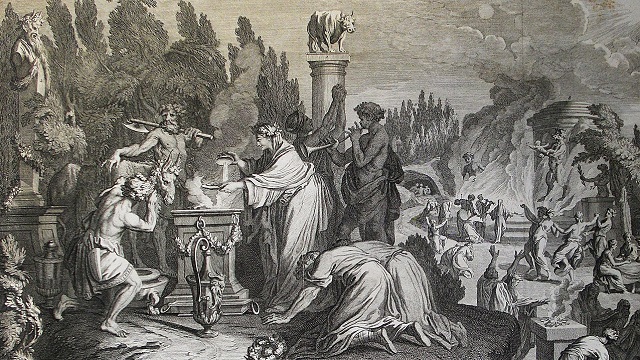
The Weird Worship of Peor
After failing to curse the people of Israel, Balaam devised another plan to make trouble for the Jewish people. He advised using Moabite and Midianite women to entice the Israelite men into worshipping Baal Peor.
How was this idol worshipped? The word 'Peor' means to ‘open up” or ‘disclose.” According to the Talmud, the worshippers would bare their backsides and defecate in honor of the idol. The Talmud (Sanhedrin 64a) illustrates the repulsive nature of this particular idolatry with the following two stories:
There was once a gentile woman who was very ill. She vowed: “If I recover from my illness, I will go and worship every idol in the world.” She recovered, and proceeded to worship every idol in the world.
When she came to Peor, she asked its priests, “How is this one worshipped?”
They told her, “One eats greens and drinks strong drink, and then defecates before the idol.”
The woman responded, “I'd rather become ill again than worship an idol in such a [revolting] manner.”Sabta, a townsman of Avlas, once hired out a donkey to a gentile woman. When she came to Peor, she said to him, “Wait till I enter and come out again.'
When she came out, he told her, “Now you wait for me until I go in and come out.”
“But are you not a Jew [and do not worship idols]?” she asked.
“What does it concern you?” he replied. He then entered, uncovered himself before it, and wiped himself on the idol’s nose.
The acolytes praised him, saying, “No one has ever served this idol so consummately!”
Exposing the True Nature of Idolatry
What was the point of this most odious idolatrous practice?
In truth, Peor was not an aberrant form of idolatry. On the contrary, Peor was the epitome of idolatry! Other forms of idolatry are more aesthetic, but they just cover up the true ugliness of idolatry. The Golden Calf was the opposite extreme, a beautiful, elegant form of idol worship. But Peor, as its name indicates, exposes the true nature of idolatry. All other forms of idolatry are just branches of Peor, with their inner vileness concealed to various extents.
The repulsive service of Peor contains the key for abolishing idolatry. When the prophet Elijah fought against the idolatry of Baal, he taunted the people: “If Baal is God, then follow him.” The people, in fact, were already worshippers of Baal. What was Elijah telling them?
Elijah’s point was that Baal is just a sanitized version of Peor. If Baal is God, then go all the way. You should worship the source of this form of worship — Peor. Elijah’s exposure of Baal as just a cleaner version of Peor convinced the people. They were truly revolted by the scatological practices of Peor, and instinctively responded, “Hashem is God! Hashem is God!” (I Kings 18:39)
Historically, the uprooting of idolatry will take place in stages. The allure of Peor, the purest form of idolatry, was shattered after Moses rooted out those who worshipped Peor at Shittim. That purge gave strength to the men of the Great Assembly who subdued the temptation of idolatry in the time of Ezra (Sanhedrin 64a). The final eradication of idolatry’s last vestiges will take place in the end of days, through the spiritual power of Moses, whose burial place faces Beit Peor. This obliteration will occur as idolatry’s innate foulness is exposed to all.
Why is idolatry so intrinsically vile?
The source of idolatry’s appeal is in fact a holy one — an impassioned yearning for closeness to God. Ignorance and moral turpitude, however, prevent this closeness, blocking the divine light from the soul. The overwhelming desire for divine closeness, despite one’s moral failings, leads to idol worship. Instead of correcting one’s flaws, these spiritual yearnings are distorted into cravings for idolatry. The unholy alliance of spiritual yearnings together with immoral and decadent behavior produces the intrinsic foulness of idolatry. Instead of trying to elevate humanity and refine our desires, idolatry endeavors to debase our most refined aspirations to our coarsest physical aspects. This is the ultimate message of Peor’s scatological practices.
True Victory over Idolatry
The Great Assembly in Ezra’s time conquered the temptation of idolatry by generally diminishing spiritual yearnings in the world. They did not truly defeat idolatry; rather, they subdued its enticement. In the words of the Midrash, they cast the temptation of idolatry into a metal cauldron and sealed it with lead, “so that its call may not be heard.” Thus we find that the Talmud (Sanhedrin 102b) records a dream of Rav Ashi, the fifth century Talmudic sage. In his dream, Rav Ashi asked the idolatrous King Menasseh, “Since you are so wise, why did you worship idols?” To which Menasseh replied, “Were you there, you would have lifted up the hems of your garment and sped after me.”
The true cure for this perilous attraction, however, is through greatness of Torah. The highest goal of Torah is the appearance of inner light in the human soul, as divine wisdom is applied to all the spheres that the soul is capable of assimilating — be it in thought, emotion, desires, and character traits.
Even nowadays, poverty in Torah knowledge results in a weakness of spirit, similar to the spiritual darkness caused by idolatry. The world awaits redemption through greatness of Torah. Then idolatry will be truly defeated, and not merely subdued in a sealed metal cauldron.
(Gold from the Land of Israel, pp. 271-273. Adapted from Shemonah Kevatzim VIII: 132; IV: 56)
Illustration image: ‘Idolatry with Baal-peor’ (The Phillip Medhurst Picture Torah 586)