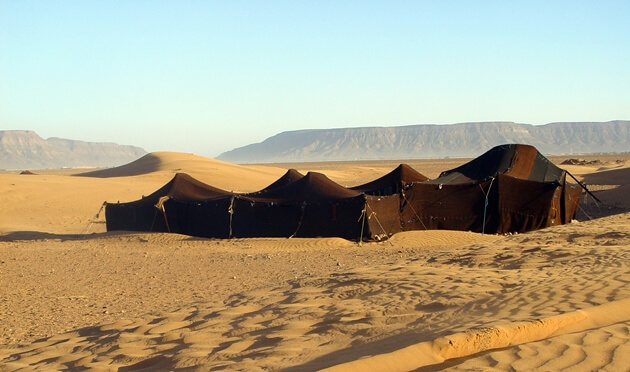
The evil prophet Balaam wanted to curse the people of Israel, but instead found himself blessing them:
מַה טֹּבוּ אֹהָלֶיךָ יַעֲקֹב מִשְׁכְּנֹתֶיךָ יִשְׂרָאֵל.
How goodly are your tents, Jacob; your dwelling places, Israel (Num. 24:5).
Is the repetition in Balaam’s blessing only poetic? Or is there a deeper significance to these two forms of shelter: the “tent” and the “mishkan” (dwelling place)?
The Journey of the Soul
As we strive to grow spiritually, we make use of two contradictory yet complementary methods.
The first method is our aspiration to constantly improve ourselves. We strive to attain greater wisdom and enlightenment. We seek to continually refine the emotions and ennoble the spirit.
The second method is the necessity to restrain our striving for spiritual growth, in order to assimilate changes and guard against spiritual lapses. We want to internalize our spiritual and ethical gains, and maintain our current level. This means that we must curb the desire for growth, so that our ambitions do not overextend the soul’s natural capacity for change.
The “tent” and the “mishkan” are both forms of temporary shelter. Both relate to the soul’s upwards journey. However, they differ in a significant aspect. The “tent” is inherently connected to the state of traveling. It corresponds to the aspiration for constant change and growth. The “mishkan” is also part of the journey, but it is associated with the rests between travels. It is the soul’s sense of calm, its rest from the constant movement, for the sake of the overall mission.
Surprisingly, it is the second method that is the loftier of the two. The desire to change reflects a lower-level fear, lest we stagnate and deteriorate. Therefore, the blessing mentions “tents” first, together with the name “Jacob,” the first and embryonic name of the Jewish people.
The need to stop and rest, on the other hand, stems from a higher-level fear, lest we over-shoot the appropriate level for the soul. For this reason, the blessing mentions “mishkan” together with the name “Israel,” Jacob’s second and holier name.
In any case, we need both aspects in order to achieve stable spiritual growth. Balaam’s prophetic blessing praises the balanced union of “How goodly are your tents, Jacob” — the soul’s longing for change — together with the more restful state of “your dwelling places, Israel,” restricting growth in order to avoid unchecked advancement, thus enabling the soul to properly absorb all spiritual attainments.
(Gold from the Land of Israel, pp. 269-270. Adapted from Olat Re’iyah vol. I, pp. 42-43)