The days from Rosh Hashanah until Yom Kippur are called Aseret Y'mei Teshuvah, the Ten Days of Repentance. During this period, our relationship with God changes, as reflected in two changes in the Amidah prayer:
-
Instead of referring to God as הָאֵ-ל הַקָּדושׁ (“the Holy God”), we call Him הַמֶּלֶךְ הַקָּדושׁ (“the Holy King”).
-
Instead of מֶלֶךְ אוֹהֵב צְדָקָה וּמִשְׁפָּט (“the King Who loves kindness and justice”), we pray to הַמֶּלֶךְ הַמִשְׁפָּט (“the King of justice”).
What is the significance of these changes?
Divine Rule during the Ten Days of Teshuvah
God governs the world in a different fashion during the Ten Days of Teshuvah. Throughout the year, His rule is revealed through the attribute of Elokut (Godliness); but during this special time, He rules with the attribute of Malchut (Kingship). What does this mean?
A king judges his subjects according to their current state, deciding who deserves punishment and who deserves reward. In the Divine rule of Malchut, evil is not tolerated.
In the elevated Divine view of Elokut, on the other hand, everything has an ultimate purpose. Even the wicked, the Sages taught, contribute to God’s praise (Shemot Rabbah 7). It may be beyond our limited understanding, but evil also serves a purpose in the world. Ultimately, the wicked, through their free choice, bring grief only to themselves.
A holy individual is one who is able to elevate all of his actions, even those that are mundane and lowly. “All of your actions should be for the sake of Heaven” (Avot 2:15). Holiness means sanctifying all aspects of life. So, too, the Divine rule of Elokut encompasses all aspects of the world, even base and evil ones, with the knowledge that they will be ultimately rectified and elevated.
During the rest of the year, God suffers evil so that the wicked will have the opportunity to repair the harm they have done. We refer to God during the year as the “Holy God,” since even base and wicked actions will, in the final analysis, lead to holy goals. This form of Divine rule emphasizes God’s kindness and forbearance, and our prayers speak of God loving both justice and mercy.
During the Ten Days of Teshuvah, however, God is revealed as the “Holy King.” The time has arrived for the wicked to mend their ways. If they fail to repent, they will be dealt with the attribute of mishpat, exacting judgment. During these ten days we experience God’s providence as a King Who rejects all evil, so at this time, we refer to Him as “the King of judgment.”
(Silver from the Land of Israel. Adapted from Olat Re’iyah vol. I, pp. 272-273)
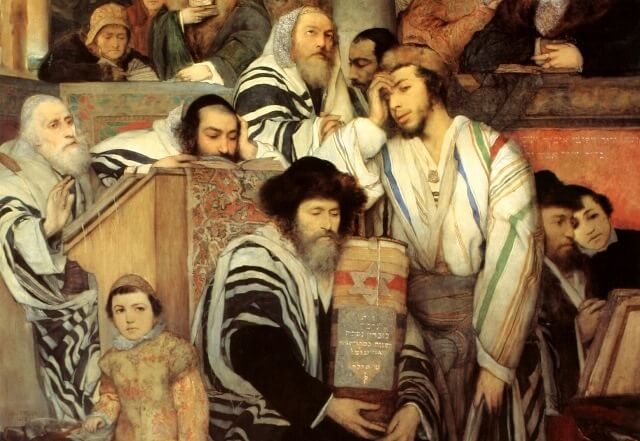
Illustration image: Jews Praying in the Synagogue on Yom Kippur. Maurycy Gottlieb, 1878.