On account of two sins, ignoramuses die young: because they call the Torah ark ‘the cabinet,’ and because they call the synagogue ‘Beit Am’ — the house of the people. (Shabbat 32a)
What is so terrible about this behavior? Are there no worse sins committed regularly by ignorant people?
Superficial Perception
We are good at seeing the functional purpose of things. You do not need not be a genius to realize that a Torah ark is meant to store Torah scrolls. Even a cursory observation indicates that a synagogue is a place where people assemble together.
Yet these functional definitions are so superficial that they fail to recognize the true essence of these objects. To perceive a Torah ark as simply a cabinet, and a synagogue as a community center, is to lose sight of the unique qualities that make them a source of spiritual influence in our lives.
This is a grave mistake. Failing to see the sanctity of a Torah ark and the holiness of a synagogue is a fundamental error in how we look at life and our relationship with God.
Holiness in the External Aspects of Life
When we reflect on God’s infinite grandeur and transcendental nature, our initial response is to view all human concerns as petty and inconsequential. All of our actions appear to be of no lasting significance, disconnected from that which is infinite and eternal.
Therefore, the most important study is precisely in this area: to understand how life’s external aspects, when they are expressions of serving God, connect to the highest levels of inner Divine knowledge. By binding the entire gamut of human activity to the loftiest contemplations, we can elevate and sanctify all aspects of life.
Life is not just the “still, small voice” — moments of calm introspection, uplifting revelations, inspiring words of prayer and supplication. Life is full of conflicts and challenges. It is noisy and rushed, flowing with joy and grief, anger and satisfaction. Deep contemplation, however, will help us recognize that God’s holiness can find us everywhere, even in our lowly physical state.
This awareness cannot come from intellectual inquiry alone; it requires profound and constant study. For this reason, the Torah is compared to water: just as water flows from mountains to lower regions, so, too, the Torah is not confined to the rarified spheres of metaphysical inquiry, but “flows down” to elevate the emotional and practical aspects of life.
Now we may better understand the true significance of the Torah ark and the error of the ignorant. The ark is not just another cabinet. By virtue of its serving as a receptacle for a sefer Torah, the Torah ark is also a holy vessel. When we recognize the holiness of the Torah ark, we acknowledge the sanctity of life’s external aspects — our actions and deeds — when they are a receptacle for Torah and mitzvot.
The Holiness in Communal Life
While the Torah ark reflects the holiness in the life of the individual, the synagogue reflects the holiness in the life of the community.
One who sees the synagogue as simply a place for people to meet fails to grasp the intrinsic sanctity of the Jewish people. Israel is not just a collection of individuals who pool together their resources for utilitarian purposes, for mutual support and protection. The true value of Israel is in the communal Divine soul that resides within them, a force of collective holiness that transcends the holiness of its individual members.
This quality of the community is especially revealed in the synagogue, a place of communal prayer and study. It is our communal holiness that transforms the synagogue into a House of God and a mikdash me'at, a miniature Temple.
As the ignorant grow in wisdom and Torah knowledge, they will come to recognize the holiness of the Torah ark. They will see that life’s external aspects, our actions and deeds, can be a source of holiness. And they will recognize the special collective holiness of Israel, realizing that the synagogue is not a “house of the people,” but rather a house of God’s Presence.
(Adapted from Ein Eyah vol. III, pp. 169-170)
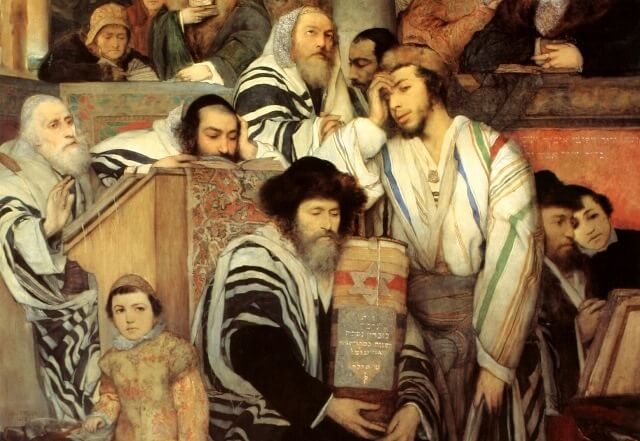
Illustration image: ‘Jews Praying in the Synagogue on Yom Kippur’ (Maurycy Gottlieb, 1878)