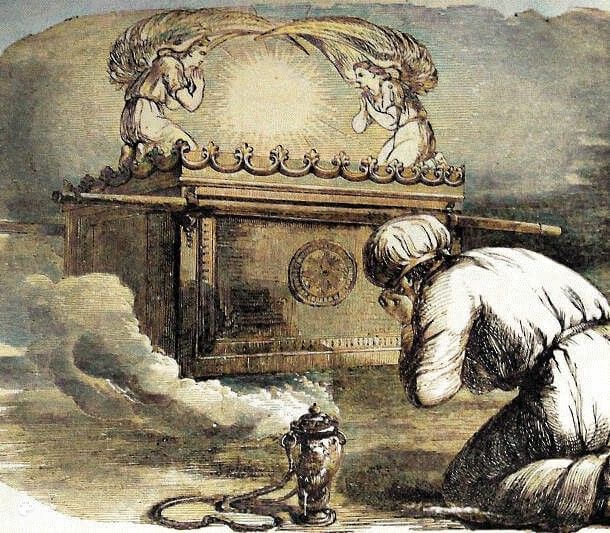
A Cloud in the Holy of Holies
The High Priest was only permitted to enter the inner sanctuary of the Temple on one day of the year — on Yom Kippur.
Tell your brother Aaron that he may not enter the sanctuary behind the partition at any time... so that he may not die, for I appear over the Ark cover in a cloud. (Lev. 16:2)
What exactly was this cloud inside the Holy of Holies? In Yoma 53a, the Talmud explains that this was a cloud of incense smoke. The ketoret (incense) played a central role in the special service of Yom Kippur. Only after burning the ketoret inside the Holy of Holies was the High Priest allowed to enter, as it says:
Then he shall take a fire pan full of burning coals... together with two handfuls of finely ground incense... so that the cloud from the incense will envelop the Ark cover. (Lev. 16:12-13)
What is this special connection between the ketoret and the Yom Kippur service? And why did it need to be finely pulverized to a greater degree than the incense that was offered on other days?
Beyond Time
Once a year, the kohanim would produce enough ketoret for the entire year. They would prepare 368 portions of ketoret — one portion for each day of the year, plus an extra three portions for Yom Kippur. Why did the service on Yom Kippur require an extra three measures of incense?
The central theme of Yom Kippur is teshuvah (repentance) and kapparah (atonement). What is remarkable about these concepts is that they allow us, in a sense, to rewrite the past. Teshuvah is not just about attaining forgiveness for past misdeeds. The Sages taught (Yoma 86b) that there is a level of elevated teshuvah through which “sins are transformed into merits.” They further explained that עִצּוּמוֹ שֶׁל יוֹם מְכַפֵּר — the very day of Yom Kippur, even without the Temple service, provides atonement (Yoma 85b). What gives Yom Kippur this unique ability to transcend time and change history?
The inner essence of the entire year is contained within Yom Kippur. The Torah employs an unusual phrase to describe Yom Kippur: אַחַת בַּשָּׁנָה — “once in the year” (Lev. 16:34). Yom Kippur has a singular quality that illuminates during the entire year. Thus the paradox: the special nature of Yom Kippur appears achat — once a year, within the framework of time — but at the same time, it is ba-shanah — it influences and elevates the entire year, transcending the normal boundaries of time.
We may distinguish between three aspects of Yom Kippur and its special relationship to time:
-
The special nature of the day itself — עִצּוּמוֹ שֶׁל יוֹם — with its own unique holiness.
-
Its ability to repair and redeem the previous year.
-
Its potential to influence and uplift the coming year.
Since Yom Kippur affects time in three directions — present, past, and future — the Yom Kippur service requires three extra measures of ketoret, in addition to the regular daily quota.
Extra Fine
Why did the ketoret of Yom Kippur need to be finely pulverized when it was prepared on the day before Yom Kippur?
Despite the fact that the scent of incense engages our most refined sense,[1] the daily ketoret is offered within the framework of time and thus relates to our physical reality. But on Yom Kippur, the incense needs to be dakah min hadakah. It is returned to the mortar and pounded until it becomes a fine powder. The ketoret of Yom Kippur must match the singular holiness of the day. It must be extraordinarily refined, unfettered by the limitations of physicality and material needs. Only then will the ketoret correspond to Yom Kippur’s lofty goals of pure thought and holy aspirations.
(Sapphire from the Land of Israel. Adapted from Olat Re’iyah vol. I, pp. 139-141)
“What is it that the soul enjoys and not the body? It is fragrant smells” (Berakhot 43b). ↩︎