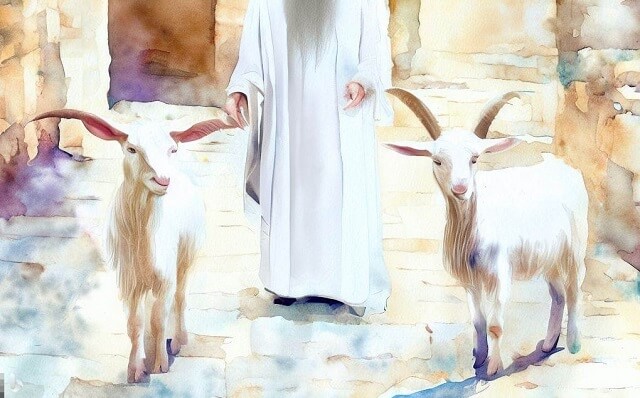
Perhaps the most unusual of all the Temple services was the Yom Kippur ceremony of Azazel, sending off a goat into the wilderness, symbolically carrying away the sins of Israel. No other Temple offering was treated in such a fashion. Even more surprising, immediately after describing the Yom Kippur service, the Torah warns, “And they will stop sacrificing to the demons who tempt them” (Lev. 17:7). The text implies that the goat sent to Azazel is the sole exception to this rule, in apparent contradiction to the fundamental principles of the Temple service.
Was this unusual ritual a “sacrifice to the demons”?
The Highest Form of Forgiveness
In order to understand the meaning of the Azazel service, we must appreciate the nature of the forgiveness and atonement of Yom Kippur.
The highest level of forgiveness emanates from the very source of divine chesed. It comes from an infinite greatness that embraces both the most comprehensive vision and the most detailed scrutiny. This level knows the holy and the good with all of their benefits, as well as the profane and the evil with all of their harm. It recognizes that all is measured on the exacting scale of divine justice, and that the tendencies towards evil and destruction also serve a purpose in the universe. Such an elevated level of forgiveness understands how, in the overall picture, everything fits together.
This recognition creates a complicated dialectic. There is a clear distinction between good and evil, truth and falsehood, nobility and debasement. Absolute truth demands that we confront the paths of idolatry and evil, in deed and thought; it opposes all repulsiveness, impurity and sin. Still, in its greatness, it finds a place for all. Only an elevated understanding can absorb this concept: how to combine together all aspects of the universe, how to arrange each force, how to extend a measured hand to all opposites, while properly demarcating their boundaries.
The forgiveness of Yom Kippur aspires to this lofty outlook, as expressed in the Azazel offering. Azazel is the worship of demons — the demonic wildness and unrestrained barbarity to be found in human nature. For this reason, the offering was sent to a desolate cliff in the untamed wilderness. The elevated service of Yom Kippur is able to attain a level that confers a limited recognition even to the demonic evil of Azazel. At this level, all flaws are transformed and rectified.
Sent Away to the Wilderness
The abstract knowledge that evil also has a purpose in the world must be acknowledged in some fashion in our service of God. This acknowledgment occurs in the elevated service of Yom Kippur. In practical ethics, however, there is no place for this knowledge. Heaven forbid that evil should be considered good, or that the wicked should be considered righteous. Therefore, the goat for Azazel was sent to a desolate, barren place — a place uninhabited by people. Human society must be based on a just way of life, led by aspirations of holiness and purity.
(Gold from the Land of Israel, pp. 200-201. Adapted from Olat Re’iyah vol. II p. 357; Shemonah Kevatzim IV:91, V:193)