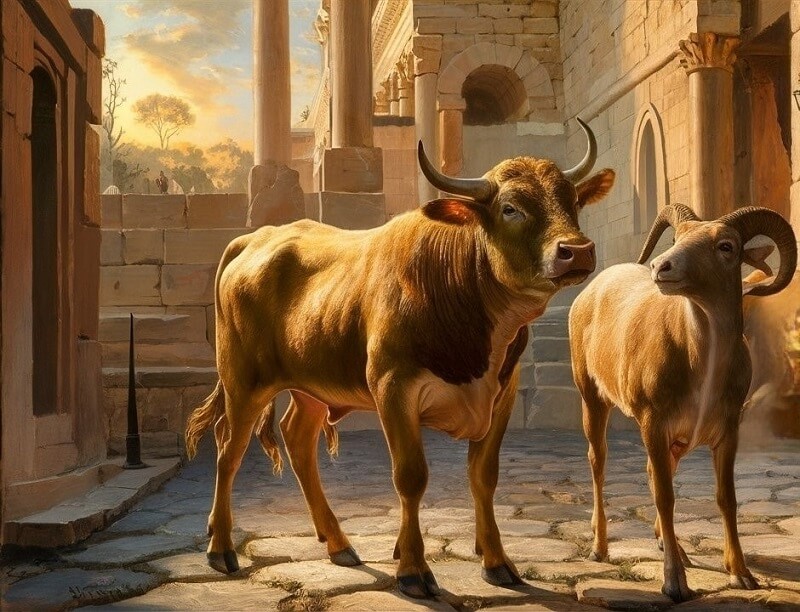
There are many unique aspects to the Temple service on Yom Kippur, the Day of Atonement. One special feature of Yom Kippur concerns the chatat sin-offerings. On all other holidays, a single sin-offering was brought, from a goat. On Yom Kippur, however, there were two sin-offerings: an ox and a goat.
What is the significance of these two animals, the ox and the goat?
Forgiveness for All Actions
The ox is a symbol of great strength. Oxen were traditionally used for construction and cultivating land. The ox’s strength was harnessed to till the earth, to transport goods, and other constructive purposes.
The goat is also a symbol of power — but of a corrosive, destructive nature. The Hebrew word for goat (sa'ir) means to storm and rage. The foraging goat devours the very roots of the plants. Overgrazing by goats leads to land-erosion and destruction of pasture.
Both of these forms of power — constructive and destructive — may be used for positive goals, and both may be utilized for evil purposes. Each has its proper place and time. We use constructive forces to build and advance, and we need destructive forces when dismantling existing structures in order to rebuild and improve. Both types of forces, however, may be abused, causing much sorrow and grief.
The most common need for atonement is when we accidentally hurt or damage. For this reason, the standard chatat offering is the goat, a symbol of blight and destruction.
On Yom Kippur, however, we seek forgiveness for the misuse of all forms of power. Therefore, we offer a second chatat from an ox, the classic beast of labor. With this offering, we express our regret if, inadvertently, our constructive deeds may have been inappropriate or harmful.
(Gold from the Land of Israel, pp. 198-199. Adapted from Olat Re’iyah, vol. I, p. 167)